


Traveling back to the history of Greece, we discover details and events unknown to most. Many parts of the country hide secrets and treasures that came to light after thousands of years. This was also the case with an ancient Greek city that no longer exists. It was located in Pindos at an altitude of 1,200 meters.
Somewhere in Eastern Pindos, in Kastri of Grevena, archaeological excavations brought to light the remains of a remarkable building complex, as well as a stone-built astyle temple. Kastri was the fortified acropolis of an ancient city in the country of the Tymphaeans in the Macedonian kingdom. However, archaeologists are not yet able to determine the name of the city and the deity worshipped there.
“It was definitely a great city, as shown by the architectural members, especially those of the impressive Doric stoa, which, together with the large building and the temple, form a large Π in the building complex,” Stella Drougou, director of the excavation, professor emeritus of Classical Archaeology at the Aristotle University of Thessaloniki, told the newspaper “Ethnos”. As far as the young man is concerned, it is believed that an important deity was worshipped there. It may have been Zeus, but also Rhea, the mother of the Gods.
What we know about the ancient Greek city
This ancient Greek city was in continuous habitation from the 4th century BC until 150 BC. Then, according to archaeologists, it was destroyed after a siege by the Romans, and even violently. This is revealed by the traces of spikes and arrowheads. “The Kastri hill was of strategic importance for the country of the Tymphaeans, as it seems to control the roads to Epirus, Thessaly, and lowland Macedonia. The form of the buildings and their foundation at the end of the 4th century BC confirm their importance already in this period, which is very well connected with the events that followed the death of Alexander the Great”, says Ms. Drougou.
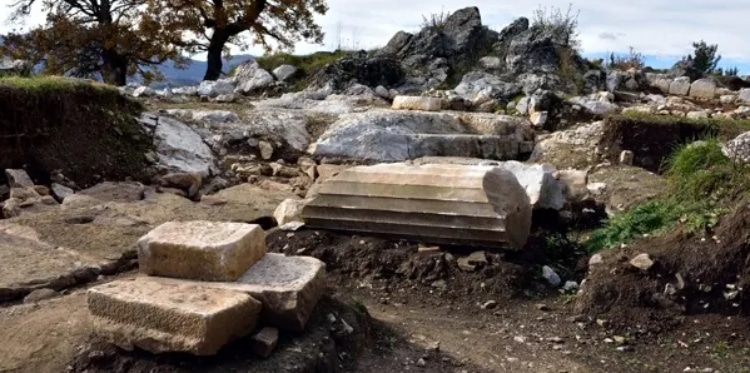
As far as coins are concerned, most are Macedonian. But there are also other regions, such as Epirus, Thessaly, and even the islands, which show its importance in space and time. This is also the case with the Astyle temple that had a built vestibule. It was roofed with a roof dating back to the 4th century BC, which occasionally underwent newer repairs. During the 3rd century BC, it was probably destroyed by fire. It also seems that in the 2nd century BC, it was occupied by the Romans. The findings so far allow the dating of this temple to the last years of Alexander’s reign or to the years that followed his death.
Exploring Greece, we discover at the same time interesting elements from its history…
Frequently Asked Questions
The unknown ancient Greek city was located in Eastern Pindos, specifically in Kastri of Grevena, at an altitude of 1,200 meters. It served as the fortified acropolis of an ancient city in the country of the Tymphaeans within the Macedonian kingdom.
The ancient city was in continuous habitation from the 4th century BC until 150 BC. It was then destroyed after a violent siege by the Romans, as evidenced by traces of spikes and arrowheads found during archaeological excavations.
Archaeological excavations at Kastri revealed a remarkable building complex including a stone-built astyle temple with a vestibule, a large impressive Doric stoa, and other significant structures arranged in a large formation. These architectural remains indicate this was an important and substantial ancient city.
While archaeologists have not yet definitively determined which deity was worshipped at Kastri, experts believe it was an important god or goddess. The most likely candidates are Zeus or Rhea, the mother of the Gods, based on the grandeur of the temple and surrounding structures.
Kastri held strategic importance for the Tymphaeans because its hilltop location controlled the roads to Epirus, Thessaly, and lowland Macedonia. The presence of coins from various regions including Macedonian, Epirote, Thessalian, and island sources confirms its significance as a major hub in the ancient world during the 4th to 2nd centuries BC.


