So, you’re German, and you’re heading to Greece for a while. Maybe it’s work, maybe it’s a long stay, maybe you’re just curious about the place before you book the flight. Either way, this little guide is for you. We’ve leaned on some cross-cultural psychology along the way (Hofstede, Hall, Meyer, a bit of Eurostat and OECD data), but we’ve tried not to turn it into a textbook. Think of it more as a long coffee with a friend who’s lived on both sides and wants to save you some confusion.
One thing before we start, and it matters: everything here is about averages and tendencies, not people. You’ll meet Greeks who run their lives by the minute and Germans who lose track of time at dinner. Culture shapes patterns, not personalities. Keep that in your back pocket as you read.
sunset at Ios Island in Cyclades
Rules: Two Different Ways of Handling Life’s Mess
Psychologists talk about something called “uncertainty avoidance” — basically, how a society handles life’s unpredictability. On Hofstede’s scale, Germany scores around 65, and Greece scores 100, which is among the highest in the world. Now here’s the twist most people miss: that high Greek score doesn’t mean Greeks love rules. It means Greek society has learned, over a long and complicated history, to manage uncertainty through people — family, friends, that cousin who knows someone at the ministry. Germans manage the same anxiety through structure, paperwork, and predictability. So when you see a Greek colleague casually working around a rule, it’s not chaos. It’s a different coping strategy. Both work. They just work differently.
Traditional village in Menalo, Peloponnese
Time: Two Brains, Two Clocks
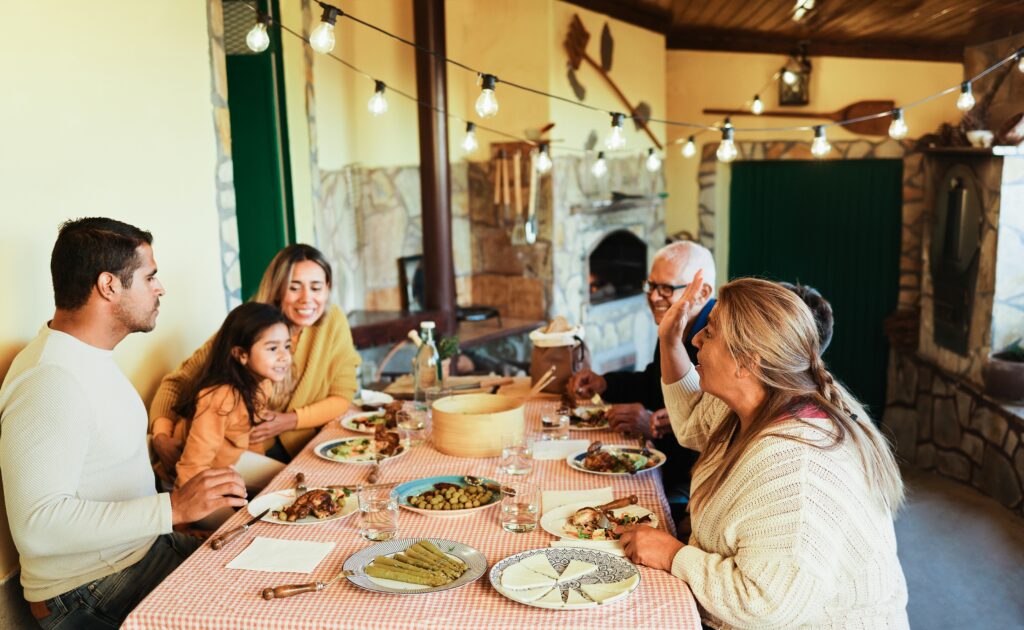
The anthropologist Edward T. Hall came up with this idea of monochronic versus polychronic cultures, and honestly, Germany and Greece could be the cover photo. Monochronic Germans do one thing at a time, in order, with edges. Eurostat puts daily social-meal time in Germany at around 80 minutes, and meetings tend to start within a couple of minutes of the agreed hour. Polychronic Greeks mix tasks, conversations, phone calls, and lunch into one big flow — and they spend roughly 120 minutes a day eating with other people, among the highest figures in the EU. It’s not that one group is efficient and the other isn’t. It’s that each culture decided long ago what its attention should serve. For Greeks, the presence of people. For Germans, getting the thing done.
Time has a different meaning in Greece
Communication: Words vs. Everything Around the Words
Hall gave us another useful split: low-context and high-context communication. Germany is famously low-context: the meaning is in the words, and the words try to be clear. Greece is high-context: meaning rides on tone, eye contact, the relationship, what was said last week, and the gesture someone made with their coffee cup. On Erin Meyer’s directness scale in The Culture Map, Germany ranks among the most direct cultures on the planet. Greece sits comfortably in the expressive Mediterranean group. Research on nonverbal communication suggests that about 70–80% of the meaning in Greek conversation is conveyed outside the words themselves, compared with about 40–50% in German exchanges. So if a Greek colleague says “we’ll see” and waves their hand a certain way — that hand is doing about half the talking. Pay attention to it.
Status: What Makes a Parent Brag
This part is fun, and it tells you a lot. Every culture has its “social elevators” — the achievements that lift a person’s standing in the eyes of others. In Greece, professions such as doctors, lawyers, professors, and engineers carry significant symbolic weight. Greek parents introduce their kids by profession, and they don’t really apologize for it. “My son, the lawyer” is its own small sentence. Surveys by the Hellenic Statistical Authority suggest around 60% of Greek parents consider a professional title a major source of family pride, and Greece has roughly 6.3 doctors per 1,000 people, one of the highest ratios in the EU (Germany is around 4.5). Medicine isn’t just a job there. It’s a ladder. In Germany, the elevator looks different. Status often comes from what you build, fix, master, or design. The word Meister — master craftsman — carries deep cultural weight, and about 1.5 million Germans hold formal Meister certifications. A German father is just as likely to brag about his daughter, the mechanical engineer who fixed a turbine problem, as a Greek mother is to brag about her son, the cardiologist. Same parental pride. Different definition of “made it.”
Family: Two Models of the Self
Hofstede’s individualism score puts Germany at 67 and Greece at 35. That number shows up in real life in obvious ways. According to Eurostat, around 58% of Greek adults aged 25 to 34 still live with their parents. In Germany, it’s about 17%. But this isn’t a story about dependence. Psychologists describe two different selves here — the “interdependent self” common in Greece, and the “independent self” common in Germany. A Greek often introduces themselves through relationships: someone’s daughter, someone’s brother, from this village, from that family. A German is more likely to lead with what they do: an engineer, a teacher, a project lead. Neither is a healthier identity. They’re just built around different anchors — one social, one personal.
Work: Where the Gap Quietly Closes
Here’s something worth knowing before you panic about cultural clashes at the office: in international and multinational settings, most differences soften significantly. Around 85% of multinationals operating in both countries run on standardized HR systems, performance reviews, and project frameworks. Studies by Eurofound show that workplace satisfaction among German and Greek employees in multinational firms differs by less than 10%, even when their broader cultural values appear quite different on paper. So in the meeting room on Teams during sprint planning, you’ll mostly feel at home. The cultural flavor comes out later, around the coffee machine, at lunch, and especially after work.
Food: Fuel for Some, Glue for Others
In Greece, food is what psychologists would call a social bonding ritual — it lights up the same neurological systems tied to attachment and belonging. A Greek dinner averages around 90 minutes. A German dinner averages closer to 30–45. It’s not about hunger. It’s about what the meal is for. Research on Mediterranean food cultures keeps finding the same thing: long shared meals are linked to higher oxytocin levels and stronger social bonds. Germans tend to separate fuel from festivity. Meals are meals. Bonding happens elsewhere — in clubs, hobbies, and planned gatherings. Roughly 40% of Germans actively participate in Vereine (associations and clubs), one of the highest rates in Europe. That’s where a lot of German social glue lives. Different containers for the same human need.
Hospitality: Filoxenia and Its German Cousin
Greek hospitality has a name — filoxenia, literally “love of strangers” — and it runs deep. National surveys suggest around 90% of Greeks consider warm hospitality a personal value, not just a nice habit. Anthropologists place Greece in the broader category of “honor-based hospitality cultures” found across the Mediterranean. Germans express the same care, but on a different frequency. A German friend probably won’t show up at your door unannounced with a tray of food. But they’ll remember your birthday three weeks in advance, arrive exactly on time, and bring something thoughtful and well-chosen. Both are real care. They just speak in different dialects.
Trust: Big Picture vs. Small Circle
The OECD’s Trust in Government index puts the share of Germans who trust public institutions at roughly 60%, compared to around 30–40% in Greece. But flip the lens, and something interesting shows up: the World Values Survey finds Greeks scoring higher on interpersonal trust within close networks — family, neighbors, old friends. Researchers call this “particularised trust” as opposed to the more generalized trust common in Germany. Greeks trust deeply but selectively. Germans trust broadly but more cautiously. Neither group is naive, nor is it cynical. They’re just running different software, written by different histories.
So What Does All This Actually Mean for You?
If you’re moving from Germany to Greece, even just for a few months, you’re not only changing your address. You’re stepping into a different psychological climate. Time stretches. Conversations get louder and longer. Family stays close, sometimes very close. Lunch is, occasionally, a small ceremony. You’ll still find German-style efficiency in plenty of places — airports, hospitals, decent-sized companies — but step outside those bubbles and life will run on its own rhythm. The honest takeaway from all the research is this: neither culture is better. They’re optimized for different things. Greeks have built a society around warmth and relationships. Germans have built one around reliability and craft. Spend enough time in Greece, and you might notice that a bit of Greek looseness fits surprisingly well next to your German precision. That combination, statistically and historically, has been quietly making Europe better for a very long time.
Uncertainty avoidance measures how societies handle unpredictability. Germany scores around 65 on Hofstede's scale, while Greece scores 100 (among the world's highest). However, this doesn't mean Greeks love rules. Instead, Germans manage uncertainty through structure and paperwork, while Greeks rely on personal relationships, family, and social networks to navigate life's unpredictability.
Germany is a monochronic culture where people do one thing at a time in sequence, with meetings starting precisely on schedule. Greece is polychronic, where tasks, conversations, and meals blend together. Greeks spend about 120 minutes daily eating with others, compared to Germans' 80 minutes. Both approaches are efficient—they just prioritize different values: Germans prioritize task completion, Greeks prioritize human connection.
Germany uses low-context communication where meaning is explicit in the words themselves. Greece uses high-context communication where meaning is conveyed through tone, eye contact, relationships, and gestures. About 70-80% of meaning in Greek conversation comes from nonverbal cues, compared to 40-50% in German exchanges. Germans are among the world's most direct communicators, while Greeks are more expressive and indirect.
While Germans follow rules through formal systems and structure, Greeks often work around rules using personal connections and relationships. This isn't chaos—it's a different coping strategy for managing uncertainty. Both approaches are valid, but they reflect fundamentally different ways societies have chosen to organize themselves throughout history.
Nonverbal communication is crucial in Greek culture. About 70-80% of meaning in Greek conversations is conveyed through tone, gestures, facial expressions, and body language rather than words alone. A hand gesture, the way something is said, or eye contact can completely change the meaning of what appears to be a simple statement like 'we'll see.'
According to Eurostat data, Greeks spend approximately 120 minutes daily in social meals with others, among the highest figures in the EU. Germans spend around 80 minutes daily on social meals. This reflects the Greek cultural priority on spending time with people and building relationships through shared meals.
Monochronic cultures like Germany focus on doing one task at a time in sequence with clear boundaries. Polychronic cultures like Greece blend multiple tasks and conversations together. Anthropologist Edward T. Hall developed this framework to explain why some cultures are punctual and task-focused while others prioritize relationships and flexibility.
In Greek culture, managing uncertainty happens through personal relationships and informal networks rather than formal rules. When a Greek colleague works around a rule, they're using a different but equally valid coping strategy developed over centuries. This reflects high uncertainty avoidance managed through people rather than systems, not a lack of respect for rules.
According to Erin Meyer's Culture Map, Germany ranks among the most direct cultures on the planet, with explicit and straightforward communication. Greece sits comfortably in the expressive Mediterranean group, using more indirect, nuanced communication that relies on context, relationships, and emotional expression rather than blunt statements.
Everything in cross-cultural guides represents averages and tendencies, not absolute personality traits. You'll meet Germans who lose track of time at dinner and Greeks who run their lives by the minute. Culture shapes patterns within societies, but individual personalities vary widely. Use cultural knowledge as a framework for understanding, not as a definitive label for individuals.
Each culture has achievements that elevate social standing. In Greece, professions like doctor, lawyer, professor, and engineer carry significant symbolic weight, and parents introduce their children by profession. Germany has different status markers based on its cultural values. Understanding these differences helps explain why certain achievements or credentials matter more in one culture than another.