


Battles, plans, generals and events that have been left in history. These make up part of the history of Ancient Greece. Some battles stand out and always have a greater interest. Like the Battle of Marathon. It is one of the most important events in the world history. There are still details we probably don’t know as they came to light later. Like, for example, who is the swamp that saved Athens from the Persians?
The Battle of Marathon took place in 490 BC between the Greeks and the Persians. The outcome was victorious for the Athenians and the Plataeans. This victory prevented the Persian invasion of Greece. There are many historians and researchers who have studied the strategy in the Battle of Marathon. So they drew many conclusions and shed light on unknown aspects of this particular battle. A special piece of information revealed by two Greek historians, K. lagos and F. karianos Their original conclusions are expressed in their book “Battle of Marathon, The Overthrow” with arguments, maps and representations.
The Battle of Marathon and the swamp that saved Athens from the Persians
There is also the exact location of the Athenian camp and its remnants, the exact location of the Greek faction and the composition of its forces, with drawings on a modern road map of the area. At this point, the use by the Greeks of Little Elus swamp (Brexiza) of Marathon is also revealed. This was the great trap that finally saved Athens from the Persians. The swamp worked so that they were trapped in it, the elite forces of the Persian Empire and then where exterminated.
This swamp that they “stuck” and defeat the Persians extence further north, where the facilities of the American base in Nea Makri were later developed. The undefeated cavalry was defeated by the Greeks in a battle that remained in history. The Greek strategic planning set as the first objective to prevent the advance of the Persians from Marathon to Athens. The aim was then to trap and neutralize the Persian cavalry and the intruder’s elite infantry forces within the passage of Brexiza and the Little Elos. That’s how it happened. Of course, how this would happen was a problem that was finally solved.
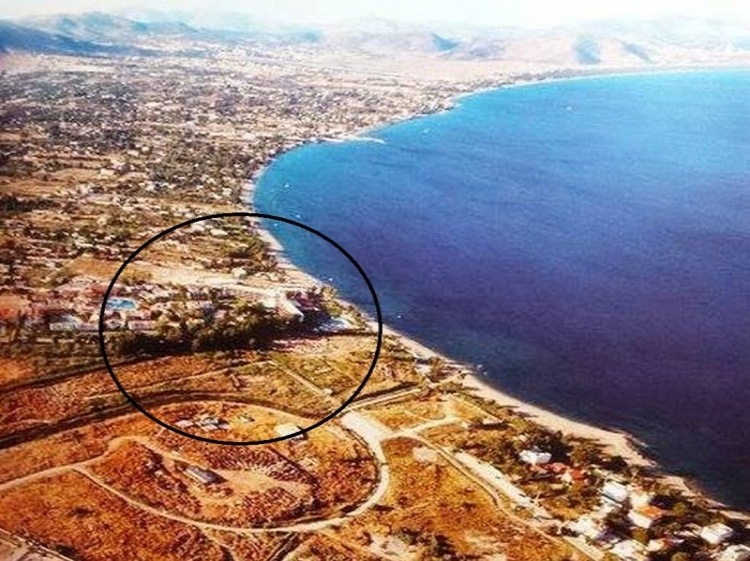
The estuary of the swamp of Brexiza. The swamp that the Persians “stuck” and defeated extended further north, where the facilities of the American base in Nea Makri were later developed. Image from the book “Battle of Marathon, The Overthrow”.
The Greek armed convoy undertook to repel the two wings of the Persian faction and then to exclude the escape route of the Persians of The Saks from the area of their entrapment, in the rear of the center of the Greek faction. The action of the lightly armed men proved to be the most important for the Greek side at the Battle of Marathon, as they lured the elite Persian forces “in the middle of the earth” through the passage of Brexiza, where they almost completely exterminate them.
The mighty Persian horsemen and infantry in the center of the Persian faction were trapped and exterminated in a well-built trap in the Little Elof of Marathon, where the Athenian arrows “literally dived into the blood of the Persian horsemen “.
Avantes: The unknown Greek race with the hard warriors
Frequently Asked Questions
The Little Elus swamp (Brexiza) at Marathon served as a strategic trap that the Greeks used to defeat the Persians. The Greek forces deliberately lured the elite Persian cavalry and infantry into the swamp passage, where they became trapped and were nearly completely eliminated. This tactical use of the natural terrain was crucial to the Athenian victory in 490 BC.
The Greek armed forces executed a two-pronged strategy: they repelled the two wings of the Persian faction while simultaneously cutting off escape routes in the rear. The lightly armed Greek soldiers lured the elite Persian forces through the narrow Brexiza swamp passage, where they were trapped and exterminated by Athenian arrows and Greek infantry forces.
The Battle of Marathon in 490 BC was pivotal because the Greek victory prevented the Persian invasion of Greece. The Athenians and Plataeans' success against the mighty Persian Empire marked a turning point in ancient history and protected Greek independence and civilization from Persian conquest.
K. Lagos and F. Karianos revealed previously unknown strategic details about the Battle of Marathon in their book 'Battle of Marathon, The Overthrow.' They provided evidence of the exact locations of the Athenian camp, Greek faction positions, force composition, and most importantly, the strategic use of the Little Elus swamp as a trap to defeat the Persian cavalry and elite forces.
The Little Elus swamp (Brexiza) of Marathon, where the Persian forces were trapped and defeated, extended further north to an area where the American military base facilities in Nea Makri were later developed. The swamp's location can be identified on modern road maps of the Marathon region in Greece.


