


The 17 large trees spring from the roof of the temple and reach a height of 20 meters. The legends according to the church of Agia Theodora are many and most known. However, you will always find a new reason to visit this temple that awes you! The church of Agia Theodora with the 17 trees on its roof, is something you do not find anywhere else in the world. Another diamond in our country.
The church of Agia Theodora and its history
The church of Agia Theodora has something special. It’s a little chapel that’s been put in the Guinness Book of Records as a “wondrous temp.” Those who find themselves on the border of Arcadia and Messinia, make a stop to admire the uniqueness offered by the church of Agia Theodora: the 17 large trees that spring from its roof and reach a height of 20meters!
The first image facing the traveler is the small stone house, with the trunks of the trees tearing the roof and rising into the sky. the Roots of the trees you can’t see them, but they’re watered by the running water that runs right next door. The image of the temple is unique. To this day, scientists are unable to explain how such a small building bears much weight. The church was built in the 12th century and due to the age but also the forced sloppy construction, the winds and weight of the branches should have uprooted the roof. At least that’s what logic thinking. That’s where other rules seem to apply.
The religious tradition
All these, of course, is of little interest to the visitors from the moment they will see the temple. The image and stories that accompany the church are of greater interest. According to religious tradition, the number of trees is not random. It corresponds to the years of Agia Theodora. There are two versions.
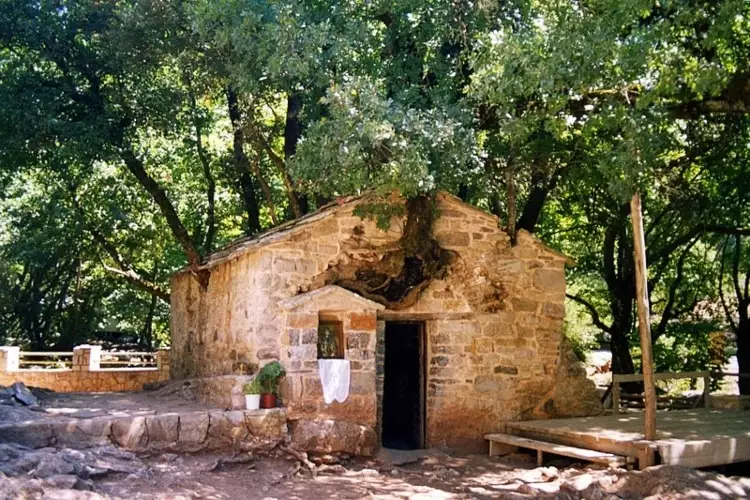
Photo Source: EdaXoyas
The first claims that she was the daughter of Emperor Constantine I of the Macedonian dynasty and reigned as a man for a year. She was succeeded by Michael VI. The legend says that he became ill and died, while it was suspected that he murdered her and enthused her where the temple exists today. According to the second version, Theodora came from a poor family and she was the eldest child. Because of the family’s financial poverty, she was forced to disguise herself as a man and serve as a mercenary soldier! Then as a man (Theodora), a young girl fell in love with her, and because there was no response, the young woman accused Theodora of having got her pregnant. Her end was predetermined.
In both stories, Theodora, who was particularly God-fearing, prayed to God, before her beheading, for her hair to become trees, her blood to flow, and her body to be a temple.
The village of Vasta in Megalopolis attracts the interest of hundreds of visitors every year and not only on September 11th, the day the church celebrates. And that’s no accident at all. it has got something very wonderful to show us.
External photography source: megalopoli.gov.gr
Read also:
Caesarian Monastery: Walk on the longest mountain of Attica
Nafplio: The picturesque old capital of Greece
Archapolis: The enigmatic Greek city and the legend of its disappearance
Frequently Asked Questions
The Church of Agia Theodora is located in the village of Vasta in Megalopolis, on the border between Arcadia and Messinia in the Peloponnese region of Greece.
According to religious legend, Saint Theodora prayed to God before her beheading, asking for her hair to become trees, her blood to flow as water, and her body to become a temple. The 17 trees on the roof are believed to correspond to the years of Agia Theodora's life and are said to be watered by running water that flows next to the church.
Yes, the Church of Agia Theodora has been recognized in the Guinness Book of Records as a 'wondrous temple' due to its unique architectural and natural features, particularly the 17 large trees growing from its roof.
The Church of Agia Theodora was built in the 12th century. Despite its age and the weight of the 17 trees reaching 20 meters in height, the small stone structure has remarkably remained standing, which scientists struggle to explain.
There are two versions of Saint Theodora's legend. The first claims she was the daughter of Emperor Constantine I who disguised herself as a man and reigned for a year. The second version states she came from a poor family and disguised herself as a male mercenary soldier. In both accounts, she was accused of pregnancy, beheaded, and her final prayer transformed her into the miraculous church and trees that exist today.


