


The color of the architecture of the Cyclades was not always white, with blue windows.
On the contrary, we would say that, in the first decades of the 20th century and further back, the complex of 24 islands had color. But how did we get the houses of the Cyclades to be white with blue windows and whitewashed alleys? We have to go back almost 90 years – 86 to be specific.
Why houses in the Cyclades are white with blue

In 1938, by decree, Ioannis Metaxas stipulated that the houses of the Cyclades should be covered with lime for protection from cholera. Lime was a solution without great cost; its disinfectant role was deemed effective.
The blue allegedly comes from a pigment of the locals, also economical, made of limestone. What color were houses before 1938? Several were in shades of intense ocher, indigo, and earthy red. And even before? In the era of pirates, before the establishment of the modern Greek state, the inhabitants of the islands did not paint their houses, as they were made of stone and thus became one with the natural environment.
Whereas if they painted them, they would give a target.
After the war, the mood for tourist promotion of Greece kept white and blue, identifying it with the sky and the sea. At the same time, the combination refers to the colors of the Greek flag, leaving no room for any misinterpretation. Today, although none of the above is valid, the tradition continues to a large extent.
The houses in the Cyclades are white with blue, but not Syros

It is interesting to note that the island that kept its architecture, having its own identity in relation to the image of the Cyclades, is the capital of the complex: Syros. The island was essentially built in the 19th century, with Hermoupolis remaining a reference point to this day.
Mansions, neoclassical, island, frescoes, colors and great architects – with one of them, Ernst Ziller having created the impressive town hall – and one of the largest in Greece.
With elements from the famous La Scala in Milan, the Apollo Theater has been built by the Italian architect Pietro Sambo.
Three special beaches in the Cyclades
We are in the Cyclades, but we will leave the white and blue of the architecture to go to the colors of the sea and sky. The beaches worth it are dozens. No list will leave everyone happy. We chose three, not because they are the best or win in points against others, but because together with the waters they have a special landscape that makes the scenery special – and sometimes magical.
Sarakiniko – Milos
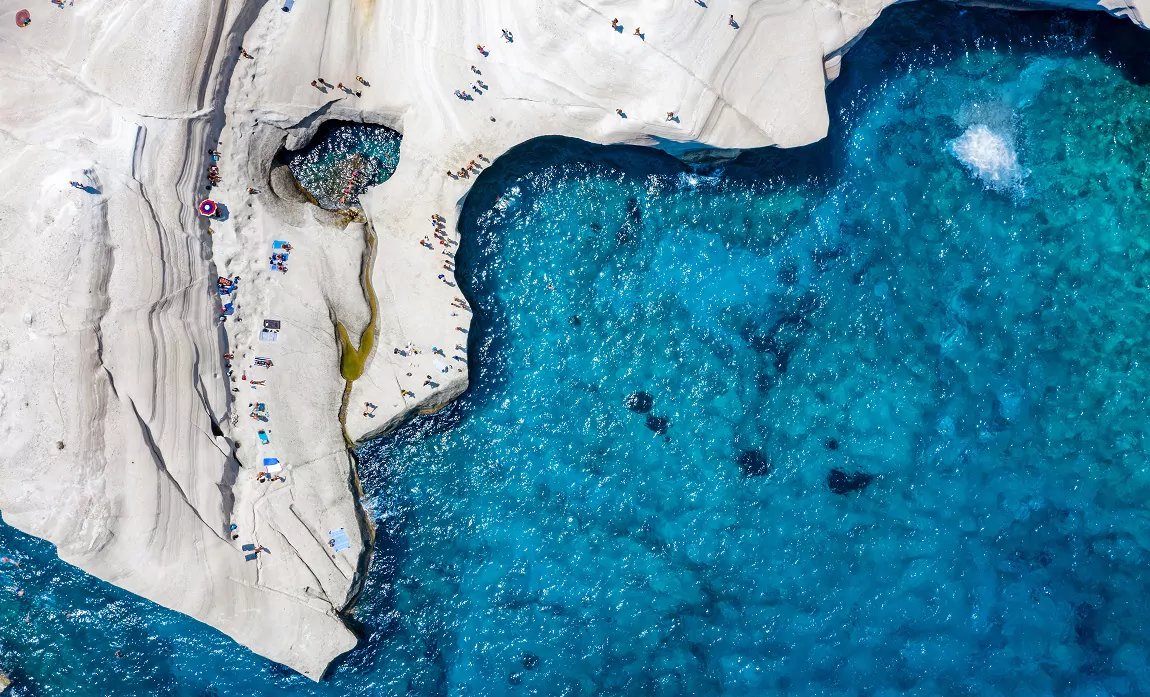
It is the most popular beach of Milos, but this description seems too short to capture the grandeur of nature, the grandeur of Sarakiniko. The white of the volcanic rock blends with the natural pools of the caves. In these caves, the Saracen pirates found refuge; from them it took its name. The scenery is breathtaking. The beach rewards visitors who usually find it difficult to get there. But when they go, they don’t want to leave.
Gala Beach – Koufonisia

Next is Gala beach, a small miracle of nature in Koufonisia. The scenery really offers a unique spectacle, as it is a rare geological phenomenon, where the sea passes under a large rock and comes out on the other side of it. “This is not just another beautiful beach in Greece, but a beach of indescribable beauty that springs up like a painting as the traveler approaches the cliff,” Conde Nast Traveller has written about this beach.
Grias Beach – Andros

Finally, the beach of Grias to Pidima has a uniqueness that has made it famous until the other side of the world. Its fame has transcended Greek borders. Rightly so, because in its crystal clear and turquoise shallow waters, you will relax and enjoy the landscape surrounded by cliffs, while in combination with the legends that follow it, you will feel part of an almost eerie and detached scenery.
Frequently Asked Questions
Το 1938, ο Ιωάννης Μεταξάς διέταξε να βαφούν τα σπίτια των Κυκλάδων με ασβέστη για προστασία από την χολέρα. Το μπλε προέρχεται από μια οικονομική χρωστική ουσία κατασκευασμένη από ασβεστόλιθο. Μεταπολεμικά, η διάθεση για τουριστική προβολή της Ελλάδας κράτησε αυτή την παράδοση, ταυτίζοντας τα χρώματα με τον ουρανό, τη θάλασσα και τα χρώματα της ελληνικής σημαίας.
Πριν το 1938, τα σπίτια στις Κυκλάδες ήταν χρωματισμένα σε αποχρώσεις της έντονης ώχρας, λουλακί και γήινο κόκκινο. Κατά την εποχή των πειρατών, πριν τη σύσταση του νεοελληνικού κράτους, οι κάτοικοι δεν έβαφαν τα σπίτια τους γιατί ήταν από πέτρα και έτσι γίνονταν ένα με το φυσικό περιβάλλον, για να μην δίνουν στόχο.
Η Σύρος, η πρωτεύουσα του συμπλέγματος των Κυκλάδων, κράτησε τη δική της αρχιτεκτονική ταυτότητα. Το νησί χτίστηκε τον 19ο αιώνα με τη διάσημη Ερμούπολη να διαθέτει νεοκλασικά αρχοντικά, το εντυπωσιακό δημαρχείο του αρχιτέκτονα Ερνέστος Τσίλερ και το Θέατρο Απόλλων του Πιέτρο Σάμπο.
Η αρχική σκοπός της ασβέστωσης ήταν προστατευτική και υγειονομική. Το 1938, ο Ιωάννης Μεταξάς ορίζει πως τα σπίτια θα πρέπει να περαστούν με ασβέστη για προστασία από την χολέρα. Ο ασβέστης ήταν μια λύση χωρίς μεγάλο κόστος και ο απολυμαντικός του ρόλος κρίθηκε αποτελεσματικός.
Μεταπολεμικά, η διάθεση για τουριστική προβολή της Ελλάδας κράτησε και εδραίωσε τα χρώματα λευκού και μπλε στις Κυκλάδες. Ο συνδυασμός ταυτίστηκε με τον ουρανό και τη θάλασσα, ενώ παράλληλα παραπέμπει στα χρώματα της ελληνικής σημαίας, δημιουργώντας μια ταυτόχρονη εθνική και διεθνή τουριστική ταυτότητα που συνεχίζεται μέχρι σήμερα.


