


The Acropolis is a miracle, but at high noon in July, it can feel less like a sacred rock and more like a human parking lot. Over three million people shuffle through the Propylaea each year, and on a busy day, the line to see the Parthenon stretches longer than the Panathenaic procession that once climbed this same slope.
Now imagine standing alone on a windswept hill in the Argolid, the only sound a goat bell clanking somewhere in the valley below, as you trace your fingers over cyclopean walls that Homer might have described. This is the Greece that exists just beyond the tourist map, and this article is a field guide to its hidden archaeological sites.
Greece holds 18 UNESCO World Heritage sites, yet the vast majority of its ancient ruins remain uncrowded, under-visited, and in some cases still half-buried. What follows are forgotten Mycenaean palaces, active excavations where you can watch history being unearthed, remote sanctuaries set in epic landscapes, and mysterious structures that still baffle archaeologists.
Why Greece’s “Unseen” Ruins Deserve Your Itinerary
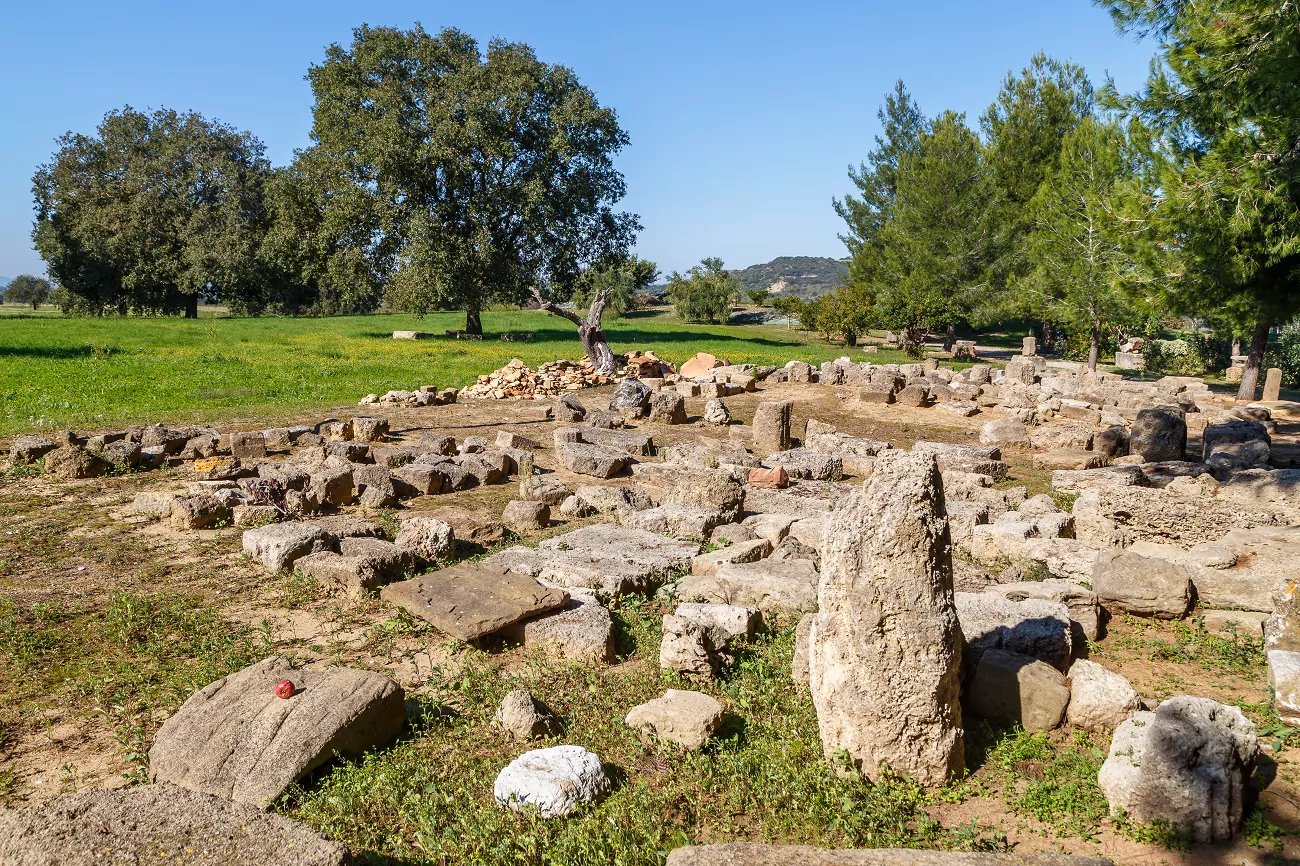
The numbers tell a stark story. While the Acropolis processes over three million visitors annually, many of the sites in this guide see fewer than fifty people per day. Some, like the island sanctuary of Despotiko, might see fifty people in a week during the off-season. This isn’t just about avoiding crowds: it’s about experiencing archaeology as a living discipline rather than a finished museum exhibit. At Ancient Messene, only about 30 percent of the city has been excavated, which means the ground beneath your feet still holds undiscovered temples, houses, and workshops. Travelers who visit these sites in 2026 will likely witness active fieldwork, with archaeologists brushing dust off pottery shards that haven’t seen sunlight for 2,000 years.
Hidden sites also tend to offer better preservation precisely because they were never rebuilt or built over after their abandonment. When a city like Messene was deserted in the late Roman period, it simply lay undisturbed, its stones slowly covered by soil and wild herbs rather than being quarried for newer construction. Visiting these places also supports local economies in rural villages and smaller islands that don’t benefit from the cruise-ship circuit. And historically, you simply cannot understand Mycenae without visiting Tiryns, or grasp the full scope of Classical Athens without seeing its rural sanctuaries. The famous sites are famous for good reason, but they are chapters in a longer story that most travelers never read.
Forgotten Mycenaean Palaces: The Bronze Age Power Centers Everyone Skips.
Forgotten Mycenaean Palaces: The Bronze Age Power Centers Everyone Skips

The Mycenaean world was a network of warrior kingdoms that dominated the Aegean from roughly 1600 to 1100 BCE. Most visitors know Mycenae itself, with its Lion Gate and shaft graves, but the civilization was far more extensive. These three sites offer a deeper dive into Mycenaean archaeology without the tour buses.
Midea: The Fortress That Rivals Mycenae
Midea sits on a conical hill exactly halfway between Mycenae and Tiryns, and in the Late Bronze Age, it was one of the three great citadels controlling the Argolid plain. Its cyclopean walls, built from limestone blocks so massive that later Greeks believed only giants could have moved them, rival those of its more famous neighbors. Ongoing Swedish excavations have uncovered a palace complex, storage rooms, and Linear B tablets that confirm Midea was an administrative center in its own right, not merely a military outpost.
To reach Midea, drive 15 minutes from Nafplio on the road toward Mycenae and watch for the brown sign pointing up a narrow lane. A rental car is essential; taxis from Nafplio will take you, but you’ll want to arrange a pickup time.
Visit in the late afternoon when the golden light spills across the Argolic Gulf and the mountains of Arcadia turn violet in the distance. Most people walk the walls and leave, but the real secret lies near the eastern fortification: a stone staircase descending into darkness leads to an underground cistern system carved directly into the bedrock.
The Mycenaeans engineered these tunnels to guarantee water during sieges, and you can still enter the first chamber if you bring a flashlight. Afterward, drive into the village of Midea proper and find To Koutouki, a family taverna where the lamb is slow-cooked with oregano and lemon in a wood-fired oven.
Agios Vasileios: The Palace That Rewrote Mycenaean History
Until 2010, no one knew this palace existed. Located on a low hill near Sparta, Agios Vasileios was discovered during a survey project and immediately yielded the largest cache of Linear B tablets ever found on the Greek mainland. The tablets mention royal officials, chariot repairs, and religious offerings, proving that Laconia had a major Mycenaean administrative center centuries before the rise of Classical Sparta. Excavations are ongoing, and during the summer field season of 2026, visitors can observe archaeologists at work in the trenches.
The site lies 20 minutes south of Sparta, signposted from the main road toward Gytheio. Go in the morning: there is no shade on the hill, and the Lakonian sun is merciless by noon. What most visitors miss is the burnt destruction layer visible in the trench walls, a blackened stratum of ash and carbonized wood that marks the palace’s violent end around 1200 BCE, the same period that saw the collapse of Mycenaean civilization across Greece. Nearby, the village of Vrontamas has a taverna called Taverna Vrontamas that serves fresh trout from the local river, grilled simply with olive oil and lemon.
Tiryns is on the tourist map, but almost everyone climbs the citadel, photographs the cyclopean walls, and leaves within 30 minutes. What they miss is the unexcavated lower town that stretches for acres around the base of the hill. Recent geophysical surveys using ground-penetrating radar have revealed a grid of streets, workshops, houses, and possibly a second palace complex buried just beneath the olive groves. The lower town housed the artisans, farmers, and soldiers who served the palace elite, and its excavation, when it comes, will transform our understanding of Mycenaean society.
Tiryns’ Lower Town: Beyond the Famous Citadel
Tiryns is 4 kilometers north of Nafplio, reachable by local bus or a pleasant bike ride along the coastal road. Arrive early in the morning before the tour groups appear. Walk the perimeter of the citadel at ground level and look for the postern gate on the eastern side, a hidden entrance built into the wall at an angle that allowed defenders to ambush attackers. It’s easy to miss if you don’t know it’s there. Nafplio itself has excellent tavernas, but for something closer, walk into the village of Nea Tiryntha and find a small grill house where the souvlaki costs a few euros, and the owner will probably show you the pottery shards he’s found in his garden.
Active Excavation Sites: Where You Can Watch History Being Unearthed

For travelers who want more than static ruins, Greece offers several sites where excavation is ongoing, and visitors can observe archaeology in real time. These are places where the ancient world is still emerging from the soil, and the experience feels less like visiting a museum and more like witnessing a discovery.
Ancient Messene: The Site That’s Only 30 Percent Uncovered
Messene is not exactly unknown, but it remains astonishingly under-visited given its scale and state of preservation. Founded by the Theban general Epaminondas in 369 BCE as a fortified capital for the newly liberated Messenian people, the city was never conquered or rebuilt, which means its theater, stadium, agora, and sanctuaries survive in remarkable condition. A travel vlogger who documented the site recently noted having it “completely to ourselves” on a perfect spring afternoon, and that experience is still common in 2026. The University of Athens continues excavations each summer, and new structures emerge annually.
Messene lies 30 kilometers north of Kalamata, served by bus but best reached by rental car. The site stays open until 8 PM in summer, and the ideal strategy is to arrive at 5 PM when the heat softens, and the low sun turns the limestone to honey. Walk through the stadium, one of the best-preserved in Greece, then climb to the theater and the Asklepieion complex. The small on-site museum houses recently excavated finds that haven’t yet appeared in guidebooks, including bronze medical instruments from the sanctuary of Asklepios. In the adjacent village of Mavrommati, To Arhontiko serves homemade pastitsio and a view of the ruins from its terrace.
The Athenian Agora: Archaeology in the Shadow of the Acropolis
The American School of Classical Studies has been excavating the Athenian Agora since 1931, and they are still digging. The Agora was the beating heart of ancient Athens, where Socrates debated, where merchants sold goods, and where democracy was practiced in the bouleuterion and law courts. Today, visitors can watch archaeologists working in the area near the Stoa of Attalos and around the Temple of Hephaestus, which is the best-preserved Doric temple in Greece, precisely because it was used as a church for centuries.
Reach the Agora from Monastiraki metro station, entering on Adrianou Street. Tuesday through Thursday are the best days to see excavation teams in action. Most visitors photograph the Temple of Hephaestus and the reconstructed Stoa and leave, but the real hidden story lies near the south entrance, where cross-section displays reveal the Byzantine layers beneath the classical level. Athens is a lasagna of civilizations, and in the Agora you can see the strata with your own eyes. Ask the guards if the excavation team is working that day; they will often point you toward the active trench, and sometimes the archaeologists themselves will explain what they’re finding.
Akrotiri: The Pompeii of the Aegean, Still Being Excavated
The Minoan city at Akrotiri on Santorini was buried by a volcanic eruption around 1600 BCE, preserving multi-story buildings, frescoes, and everyday objects under meters of ash. A new roof structure and walkways, completed in 2024, have improved visitor access to active excavation areas; in 2026, the site remains a working dig. Unlike Pompeii, no human remains have been found at Akrotiri, suggesting the inhabitants had a warning and evacuated before the final eruption.
Take the bus from Fira to Akrotiri village, a 20-minute ride along the caldera’s edge. Arrive at the 8 AM opening to beat the cruise ship crowds that arrive by mid-morning. The site is entirely indoors, which makes it a good choice for hot or rainy days. Most visitors follow the walkway and admire the buildings, but near the exit, there are windows into the fresco restoration workshop where conservators piece together the famous wall paintings of swallows, lilies, and boxing children. Afterward, walk down to the harbor and find To Psaraki, a fish taverna where the catch comes straight off the boats, and the caldera views stretch all the way to the volcano.
Remote Sanctuaries With Epic Landscapes: Where Gods Met Mountains

Some of Greece’s most powerful ancient sites are not cities or fortresses but sanctuaries, places where Greeks traveled to consult oracles, perform rituals, and connect with the divine. These three are set in landscapes so dramatic that the journey itself feels like a pilgrimage.
Dodona: Greece’s Oldest Oracle, Older Than Delphi
Long before Apollo spoke through the Pythia at Delphi, Zeus delivered prophecies at Dodona through the rustling leaves of a sacred oak tree. Located in a valley in Epirus, surrounded by the mountains of the Pindus range, Dodona feels remote and ancient in a way that Delphi, for all its grandeur, no longer does. The site includes one of the largest theaters in Greece, a bouleuterion, and the foundations of the oracle sanctuary where priests interpreted the god’s voice in the wind.
Dodona is 22 kilometers southwest of Ioannina, reachable by rental car or a twice-daily bus. Go in the late afternoon when the mountains cast long shadows across the valley, and the theater’s stone seats glow amber. The site museum holds the lead oracle tablets, thin sheets of metal inscribed with questions that ordinary Greeks asked Zeus: Should I marry this woman? Will my voyage be safe? Is my son really mine? These are not the grand questions of epic poetry but the intimate anxieties of real people, and they bridge the millennia with startling immediacy. In the village of Dodoni, To Manteio serves local feta, grilled meats, and Epirus’s distinctive savory pies.
Despotiko: The Island Sanctuary You Need a Boat to Reach
Despotiko is an uninhabited island just off Antiparos in the Cyclades, and since 2001, excavations have uncovered an extensive sanctuary of Apollo that rivals Delphi in scale. Marble kouroi, temple foundations, and a massive archaic complex have emerged from the scrub, and the island’s emptiness gives the site an almost mystical quality. There are no ticket booths, no gift shops, no audio guides, just the wind and the sea and the ruins of a god’s house.
Boats leave from Antiparos harbor, a 20-minute crossing, but schedules are informal: ask at the harbor or check with local fishermen. Take the first morning boat, and you will likely have the island to yourself. Walk the sanctuary, then follow the faint path to the north side of the island, where an ancient marble quarry supplied the stone for the statues and temples. The quarry face still bears chisel marks from the 6th century BCE. Back on Antiparos, Captain Pipinos serves grilled octopus and cold beer on a terrace overlooking the harbor.
Samothrace: The Sanctuary of the Great Gods
The Winged Victory of Samothrace, that masterpiece of Hellenistic sculpture that dominates a staircase in the Louver, was discovered on this remote island in the northern Aegean. The Sanctuary of the Great Gods was home to a mystery cult that rivaled Eleusis, promising initiation, protection at sea, and a blessed afterlife. The sanctuary sits in a gorge with waterfalls and wild plane trees, a setting unlike any other Greek archaeological site. The marble remains glow white against the deep green of the forest, and the sound of running water is constant.
Reach Samothrace by ferry from Alexandroupoli, then take a bus or taxi to the site at Paleopolis. Midday is best, when the sun illuminates the ruins against the gorge’s shadow. Most visitors see the Hieron and the Rotunda and leave, but the real secret is the Anaktoron, the initiation hall where the mystery rites were performed. Look for the sunken chamber with stone benches lining the walls, where initiates sat in darkness before receiving the gods’ revelation. In Paleopolis, Taverna Karydies serves goat stew and local wine under a vine-covered arbor.
Ruins Hidden in Plain Sight: Athens’ Underground Archaeology

Athens is a city built on its own past, and some of its most fascinating ancient Greek ruins are not on hilltops but beneath your feet. The construction of the Athens Metro in the 1990s and early 2000s uncovered a subterranean city, and many of these finds are now on display in the stations themselves.
The Roman Baths Under the Monastiraki Flea Market
Beneath the square where vendors sell leather sandals and vintage komboloi beads lies a well-preserved Roman bath complex. A glass floor allows visitors to look down into the chambers, and a small entrance on Areos Street provides closer access. The hypocaust system, the underfloor heating that circulated hot air beneath the marble floors, is clearly visible, a reminder that Roman Athens was a city of comfort as well as philosophy. Visit on a Tuesday or Wednesday when the flea market is less crowded, and you can stand on the glass without being jostled.
Ancient Walls Inside Syntagma Metro Station in Athens
During the excavation of Syntagma station, workers uncovered a 4th-century BCE cemetery and sections of the ancient city wall. Rather than remove the finds, the architects incorporated them into the station design. Glass cases along the platforms display burial offerings, including a gold myrtle wreath so delicate it looks like it might crumble at a touch. The station is a free museum, open whenever the metro runs, and thousands of commuters pass these artifacts every day without stopping to look.
Byzantine Layers Beneath the Acropolis Metro Station in Athens
The Acropolis station excavation revealed 11 layers of habitation, from Mycenaean tombs through Byzantine cisterns to Ottoman pottery. The mezzanine level displays artifacts from each period, and the stratigraphy is explained in clear, non-technical panels. Combine a visit here with a morning at the Acropolis itself, descending to the station as the heat builds. The Byzantine cistern, a vaulted brick chamber that once stored water for the neighborhood, is particularly evocative, a reminder that Athens has always been a city of layers.
Mysterious Sites With Unsolved Questions: Greece’s Archaeological Puzzles

Some ancient sites resist easy explanation. These three are genuine archaeological puzzles, places where even the experts disagree about what they were, who built them, and why. For travelers who love a mystery, they are irresistible.
The Dragon Houses of Evia (Drakospita)
Scattered across the mountains of southern Evia are massive stone structures built from enormous blocks fitted together without mortar. The largest, on Mount Ochi, has a corbelled roof and walls over a meter thick. No one knows who built them or why. Theories range from Mycenaean fortresses to ancient astronomical observatories to temples of Hera. The name “dragon houses” comes from local folklore, which held that only dragons could have moved stones so large.
Reach the Mount Ochi dragon house by hiking from the village of Styra, a two-hour walk on a marked trail, or drive partway on a dirt road if you have a four-wheel-drive vehicle. Start early in the morning to avoid the summer heat on the exposed mountain. Look for the carved channels on the roof stones, possibly used for pouring liquid offerings, a detail that supports the sanctuary theory. Back in Styra, To Limani serves fresh fish and a view of the harbor where the ferry from Athens docks.
The Pyramid of Hellenikon (Argolis)
Near the village of Hellenikon in the Argolis stands a pyramidal structure that some researchers claim predates the Egyptian pyramids. The ancient travel writer Pausanias, in the 2nd century CE, described it as a mass grave for soldiers who died in a legendary battle. Modern archaeology tends to interpret it as a guard post or farm building, but the debate continues. The structure is small, about 7 meters tall, with a corbelled interior chamber and an undeniably pyramidal shape.
The pyramid is 15 kilometers from Nafplio and is signposted from the main road. Visit in the late afternoon when the low sun casts dramatic shadows across the stone face. Bring a flashlight to enter the interior chamber and look up at the corbelled ceiling, a technique of stacking stones so that each course projects slightly inward until they meet at the top. It’s a simple structure, but standing inside it on a quiet afternoon, with the Argolid plain stretching to the sea, you understand why it has inspired centuries of speculation.
Eleutherna: The City That Refuses to Give Up Its Secrets
On the slopes of Mount Ida in Crete, the ancient city of Eleutherna was continuously inhabited from the 9th century BCE through the Byzantine era, and excavations have revealed a staggering range of finds: Geometric period burials with gold jewelry, an aqueduct system, Hellenistic houses, and early Christian churches. The site is still being excavated, and the “Museum of Ancient Eleutherna” in the nearby village is a world-class institution displaying recent discoveries.
Eleutherna is 30 kilometers southeast of Rethymno, reached by rental car on a winding mountain road. Visit the museum in the morning to see the finds, then drive up to the archaeological site in the afternoon when the light is best for photography. The museum’s display of the “Warriors of Eleutherna,” Geometric period burials of young men with their weapons and jewelry, is haunting and beautiful. In the village, To Steki tou Papa serves traditional Cretan cuisine: slow-cooked goat, wild greens, and raki distilled by the owner himself.
Practical Field Guide: How to Plan Your Hidden Ruins Tour

Best Time of Year for Off-the-Beaten-Path Sites
April through May and September through October offer ideal conditions: mild temperatures, fewer visitors, and longer site hours than winter. From June through August, early-morning visits are essential; many remote sites close by 3 PM due to the heat. From November through March, some sites reduce hours or close entirely, so check the Greek Ministry of Culture website before traveling. For the 2026 season, several sites, including Messene and Despotiko, plan to extend summer hours in response to growing interest in alternative destinations.
Transportation Tips for Remote Sites
A rental car is essential for most sites on this list. Book well in advance for 2026, especially if you want an automatic transmission. Public buses serve major hubs such as Nafplio, Sparta, and Ioannina, but do not reach destinations like Midea or the Pyramid of Hellenikon. For island sites such as Samothrace and Despotiko, check ferry schedules in advance: off-season service is limited, and weather can cause cancellations. In the Argolid, consider hiring a local driver or guide for a day to reach Midea, Tiryns, and the pyramid efficiently; Nafplio has several excellent English-speaking guides who specialize in Mycenaean archaeology.
What to Bring for a Day of Ruin-Hopping
Sturdy walking shoes are non-negotiable. Many of these sites have uneven terrain, loose stones, and no paved paths. Carry at least a liter of water per person; most remote sites have no vendors or shade. Sun protection and a hat are essential even in spring and autumn. A flashlight unlocks underground chambers at the Pyramid of Hellenikon and the cisterns at Midea. Download the free “Archaeological Travel Guide Greece” app for offline maps and site information. And bring cash: many smaller sites do not accept credit cards for entry fees, which typically range from 4 to 8 euros.
Budget Planning for this year’s trip to Greece
Most hidden sites charge between 4 and 8 euros for entry. The Syntagma metro station displays, and the Roman baths under Monastiraki are free. The “Archaeological Pass” costs 30 euros and covers 10 major sites, including the Acropolis and Mycenae, but it does not cover most of the places in this guide, so calculate whether it makes sense for your itinerary. Village taverna meals remain remarkably affordable: 10 to 15 euros per person buys a full meal with wine, bread, and a main dish. Accommodation in Nafplio, Ioannina, and the smaller towns near these sites is significantly cheaper than in Athens or Santorini.
The Greece That Most Travelers Never See

These sites offer something the famous ruins cannot: a personal connection to the past, unmediated by crowds, selfie sticks, and roped-off viewing platforms. You do not need to visit all of them. Pick one or two that match your route and your curiosity, and give them the time they deserve. Arrive early, stay late, ask questions, and let the place work on you. Visiting these hidden archaeological sites in Greece also supports ongoing excavation and conservation work and brings income to villages that the tourist economy has largely bypassed. If you have discovered other underrated sites in Greece, or if this guide helps you plan a trip, share your experience in the comments. Bookmark this page, send it to your travel partner, and start planning for this year’s journey into the secret life of ancient Greece.


