


A city whose name contains the word “victory” can only be indifferent. You know and imagine that history has been made there. And so it is. The historic Nikopolis in Preveza has a feature that few know about. It is the largest ancient city in Greece. Apart from beauty, she has other reasons that will convince you to get to know her. In fact, it is a town that now counts few inhabitants but is a popular tourist destination in Epirus.
Meet Nikopolis, the largest ancient city in Greece
Nikopolis is also called the Greek “Pompeii” and not unfairly. The beautiful and historic town is built on the peninsula, which separates the Ambracian Gulf from the Ionian Sea. It was an important commercial center in the past centuries as land and sea routes led there. But why was it called Nikopolis? It was named because it was founded as a symbol of the great victory of Gaius Julius Caesar Octavian and later Roman emperor Augustus, against Mark Antony and Cleopatra VII of Egypt at Actium in 31 BC.
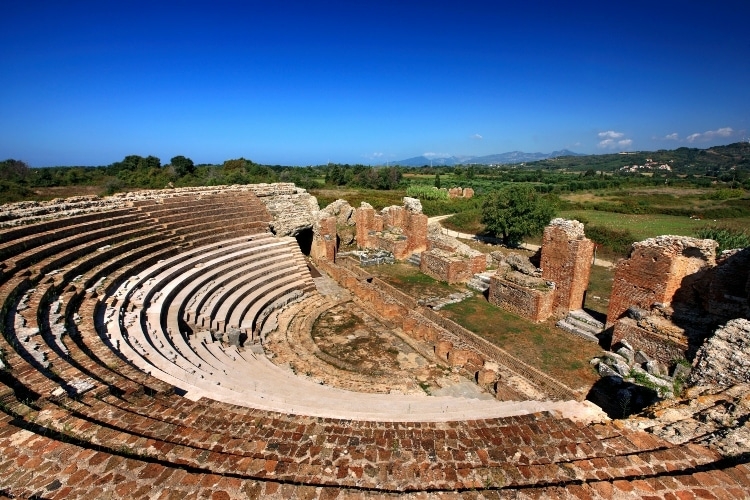 It was the administrative capital of Epirus for 7 centuries. Octavian, in order to give life to his ambitious plan, transferred to the new city populations of the largest Greek cities in the wider region. Nikopolis is estimated to have had up to 100,000 inhabitants during its heyday, being one of the largest urban centers of the Roman world. It is characteristic that from the beginning of the 7th century. References to sources and excavation finds are rare. Thus, no safe conclusions can be drawn about the continuity of urban life.
What was certain and indisputable was that Nicopolis was the pride of the Roman emperor Octavian. And it could not be otherwise, since it was the settlement that he created in memory of his victory against the allied fleet.
Nikopolis of Preveza today…
Today, Nikopolis is a unique and important archaeological site in Greece. The extent and the “monumental cores” can be said to compose the puzzle for the most complete unified example of Greco-Roman culture and way of life. Nikopolis is an ideal destination for anyone who likes to take a deep journey through history.
Travel to Greece – Google News – Follow us
Read also:
The Greek film village with two names
The deep lake of Greece and the myth of the girl with the well
Why did this famous Athenian statue stay in the workshop for 38 years?
The ancient triangles of Greece: Journeys of mystery and unparalleled beauty
The paradox with the monument of Leonidas at Thermopylae
Follow exploringgreece.tv on Instagram and Facebook
Frequently Asked Questions
Nikopolis is an ancient city located in Preveza, Epirus, and is the largest ancient city in Greece. It was founded by Roman Emperor Augustus (Octavian) in 31 BC to commemorate his victory against Mark Antony and Cleopatra VII at the Battle of Actium. During its peak, Nikopolis had an estimated population of up to 100,000 inhabitants, making it one of the largest urban centers of the Roman world.
Nikopolis was founded by Gaius Julius Caesar Octavian (later Emperor Augustus) as a symbol of his great military victory against Mark Antony and Cleopatra VII of Egypt at Actium in 31 BC. The name 'Nikopolis' comes from Greek and means 'City of Victory,' reflecting the city's purpose as a monument to this triumph.
Nikopolis served as the administrative capital of Epirus for approximately 7 centuries. During this period, it developed into an important commercial center due to its strategic location on a peninsula separating the Ambracian Gulf from the Ionian Sea, where both land and sea routes converged.
Nikopolis is often called the Greek 'Pompeii' due to its well-preserved archaeological remains and historical significance. Today, it is a unique and important archaeological site that provides one of the most complete unified examples of Greco-Roman culture and way of life in Greece.
Yes, Nikopolis is an ideal destination for history enthusiasts who want to take a deep journey through ancient history. Today, it is a popular tourist destination in Epirus that showcases extensive monumental structures and archaeological findings that illustrate the grandeur of Roman civilization and the cultural heritage of ancient Greece.


