


Athens, in many places, looks like an open museum with the various statues reminiscent of moments from the past. Many of them have their own story sometimes more straightforward and other times more strange. Like the story of a well-known statue of Athens that stayed in the workshop for 38 years. Which is it? It is called The woodcutter.
The woodcutter and his story
When you walk downwards the Herod Attikos street, a little before you reach Vasilissis Olgas avenue, you will see a marble statue in a clearing of Zappeion Garden. It is the woodcutter, the most emblematic work of the sculptor Dimitris Filippotis. The statue is a representation of a naked man who breaks a log using hands and feet. Despite being considered by many connoisseurs, a masterpiece, the sculpture has gone through various adventures.
Filippotis began sculpting the woodcutter in his workshop in Patissia in 1871. Initially he made it in plaster and much later in marble. He considered it a milestone in his artistic creation and required from the state to finance its construction as a work equal to the ancient works of the classical period. So for many years in arow, every New Year’s Eve, he took out the plaster model outside his workshop in Patision avenue. What did he do next? He lit candles around it and protested that such a masterpiece remained unfinished because of the indifference of the state.
30 years passed until 1901, when the marble “woodcutter” was finished, after all these adventures, at the sculptor’s expenseEven then, and although it was put on display at an exhibition and its value was widely recognized, no one offered to buy it. Six years later and while the statue was still in the workshop, the National Gallery made a proposal. However, Filippotis rejected this proposal also. Until finally in 1908, the mayor of Athens Spyros Merkouris doubled the offer. Then the sculptor accepted, but not with great pleasure.
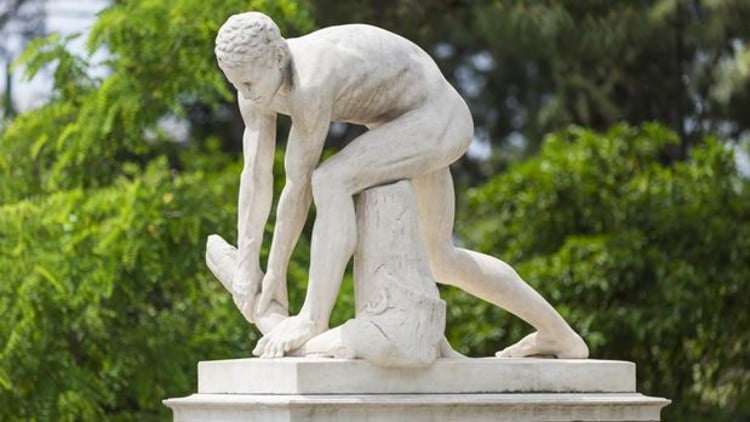
The well-known statue of Athens that spent 38 years in the workshop and the attack on the genitals
It had already been 38 years since he started sculpting it. A decision was made that the sculpture would be placed in Amalias avenue behind the Russian Church at the end of Filellinon street. Unfortunately, the lumberjack was met with more adventures. In 1910 someone went and threw a red dye in his face which was indelible with the chemical solutions of that time. Then, in 1912 the “woodcutter” was vandalized again when a stranger went and broke his genitals and has since been castrated. That is why a lot was rumored and even more was written in the press of the time.
However, despite the latter event, the “woodcutter” stayed in the same place for another fifty years. Finally in 1960 with the expansion works of Amalia Avenue, he was moved to Zappeion Garden where it is located to this day.
With information from: A drop of history, by Dimitris Kambourakis
The buried river of Athens that passed by the Acropolis
Frequently Asked Questions
The Woodcutter statue, created by sculptor Dimitris Filippotis, remained in his workshop for 38 years because the Greek state refused to finance its marble construction despite the sculptor's repeated protests. Although Filippotis began the sculpture in 1871, it wasn't completed in marble until 1901 at his own expense. Even after completion, no one purchased it for six years until Athens mayor Spyros Merkouris made an offer in 1908, which the sculptor reluctantly accepted.
The Woodcutter is a marble statue located in Zappeion Garden in Athens, created by renowned sculptor Dimitris Filippotis. It depicts a naked man breaking a log using his hands and feet. Originally placed on Amalias Avenue in 1908, it was relocated to its current location in Zappeion Garden in 1960 during expansion works.
The Woodcutter was created by Greek sculptor Dimitris Filippotis, who considered it a masterpiece and a milestone in his artistic career. He believed the sculpture was equal in quality to ancient classical period works and therefore requested state financing for its creation in marble. The work is now considered one of the most emblematic sculptures in Athens.
The Woodcutter statue faced several vandalism incidents after being installed in 1908. In 1910, someone threw red dye on its face that couldn't be removed with available chemical solutions. In 1912, a stranger vandalized the statue by breaking its genitals. Despite these attacks, it remained in its original location for fifty years before being moved to Zappeion Garden in 1960.
For 30 years, Filippotis protested the state's indifference toward his Woodcutter sculpture by taking the plaster model outside his workshop on Patision Avenue every New Year's Eve. He would light candles around the sculpture as a public demonstration against the government's refusal to finance the marble version of what he believed was a masterpiece equal to ancient classical works.


