


Without a doubt, Plaka stands as one of the most scenic and charming districts in Athens. A leisurely stroll through Plaka provides a soothing experience, transporting you to a time when Athens was steeped in antiquity.
Plaka and its name
Plaka, once confined to the area now known as the Lysikratos monument or ‘Diogenes Lantern’ as it’s referred to by the younger generation, is steeped in history and intrigue. The origin of its name has been a topic of much debate among historians and researchers in Attica, with various theories circulating. The most widely accepted explanation, proposed by renowned Athenian chronographer Dim. Kambouroglou, suggests that Plaka was named after a large marble slab found near the quaint church of Agios Georgios of Alexandria. This church is nestled on the eastern slopes of the Acropolis, close to Thespidos Street.
Kambouroglou, despite his extensive research, did not provide any details about whether the marble slab that gave Plaka its name was embossed, inscribed, or of any particular significance. However, Dimitrios Sisilianos, a prominent scholar of Athenian history, expressed skepticism about this theory in his book “Old and New Athens”. He doubted that a simple marble slab could have garnered enough attention from the locals to inspire the name of an entire district.

However, the true origin of the name “Plaka” remains a matter of debate. Architect and urban planner Kostas Biris, author of numerous books about Athens and its place names, also believed that the name “Plaka” was of Albanian origin. He suggested that it was brought to the area by Albanian mercenaries who settled there after the unsuccessful Orlov Revolt against the Ottomans in 1770. These mercenaries, left unemployed after the revolt, were housed by the Turks in the area around the Lysikratos monument.
Plaka today
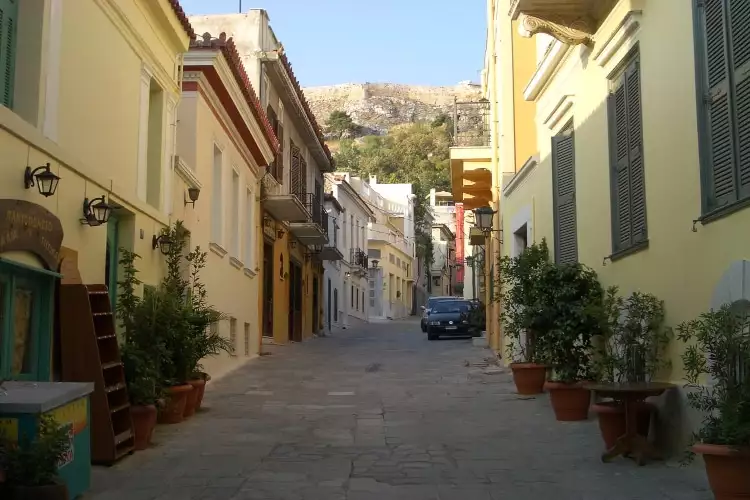
Photo Source: JFKennedy
Strolling through Plaka today feels like stepping into a different dimension, perhaps even a different city. It’s no surprise that many visitors find it reminiscent of an island. The journey through Plaka is like a voyage back in time to the old Athens, when houses were whitewashed, freshly painted, and adorned with flowers on the balconies. The colors and scents of Plaka carry an undeniable authenticity.
A leisurely stroll through Plaka is always a rejuvenating experience, brimming with energy. Embark on this journey on a relaxed Sunday, meandering between ancient and modern landmarks. As you ascend to Anafiotika, you’ll be captivated by the charming and well-maintained houses. After wandering through the alleyways and cobblestone streets, take a moment to rest on the stairs and savor a “rakomello” (raki with honey) if the weather permits. No matter which shop you choose to unwind in, you’re sure to enjoy a pleasant time over a cup of coffee or a glass of wine.
In a time when the face of Greece’s capital is rapidly changing, Plaka remains the most “authentic” district of the city, serving as a window to the Athens of yesteryears. A simple walk through its streets unfolds the city’s history from antiquity to the present day. If you haven’t experienced it yet, it’s certainly worth a try…
Information from the book: “In Plaka’s acclivities”, Filippotis edition, by Giannis Kariofillas
Travel to Greece – Google News – Follow us
Read Also:
Abyssinia Square: The special history of its name
The water-carrier, the iceman and other vanished professions of old Athens
Gone forever: the old neighborhood under the Acropolis
Follow ExploringGreece.tv on Instagram and Facebook
Frequently Asked Questions
The origin of Plaka's name has been debated by historians. The most widely accepted theory, proposed by Athenian chronographer Dim. Kambouroglou, suggests it was named after a large marble slab found near the church of Agios Georgios of Alexandria on the eastern slopes of the Acropolis. However, other scholars believe the name comes from the Albanian word 'Pliaka,' meaning 'old,' referring to old Athens. Architect Kostas Biris suggested the name was brought by Albanian mercenaries who settled there after the 1770 Orlov Revolt.
No, Dimitrios Sisilianos expressed skepticism about the marble slab theory in his book 'Old and New Athens.' He doubted that a simple marble slab could have garnered enough attention from locals to inspire the name of an entire district. Instead, he found the Albanian origin theory more plausible, where 'Pliaka' means 'old' and could refer to old Athens.
The Albanian word 'Pliaka' translates to 'old,' referring to either an old woman or something old in general. According to this theory, Albanian-speaking people around Athens referred to the district as 'Pliaka Athens,' meaning 'old Athens.' Once Hellenized, this term evolved into the modern name 'Plaka,' making it a reference to the old quarters of Athens.
According to architect Kostas Biris, Albanian mercenaries settled in the Plaka area after the unsuccessful Orlov Revolt against the Ottomans in 1770. Left unemployed following the failed revolt, these mercenaries were housed by the Turkish authorities in the area around the Lysikratos monument, eventually establishing the district we know today as Plaka.
Plaka remains the most authentic district of Athens because it preserves the charm and character of old Athens with whitewashed houses, freshly painted buildings adorned with flowers on balconies, and well-maintained cobblestone streets. Walking through Plaka feels like traveling back in time, offering visitors a glimpse into the city's history from antiquity to the present day, making it a unique window to traditional Athenian life.


