


You may be hearing these names for the first time, but when you see what special and beautiful places they respond to, you will surely stay with dumbfounded and make plans as to how you can get to know them up close. We are talking about Chiona and Grandes, two exotic, neighbouring places in Crete that remain unexplored from the general public (those outside of Crete). The images speak for themselves about their beauty and peculiarity that make them have unparalleled beauty.
Chiona Beach and Grandes Islets, the exotic corner of Greece
Chiona Beach and Grandes Islets are located in the easternmost part of Crete and are an exotic paradise. It has been discovered and visited, in fact, mainly by locals, so this makes this place even more charming for foreigners.
The beautiful beach with the strange name of Chiona, has calm shallow waters and fine golden sand. You will find it even further east than Agios Nikolaos and very close to Sitia. A beautiful place where people from all over Crete arrive not only for the crystal clear waters but also to taste the delicious fish and other sea-food and the “kakavia” (special soup made of small fish) in the adjacent taverns. It is a beach on which you will find enough space to spread a straw-towel and set up your umbrella. It has, of course, a lot of natural shade. The tamarisk trees will offer you all the coolness you need.
Where did this beach get its name from? The name Chiona comes from the “chiona”, ie the carob store. What many do not know, out of Crete, is that the whole region was highly dependent on the locust-bean trade. So they’d put them on the “chiona” (locust-been store) before they were to be transported by ships. That’s how the name stayed on this particular beach.
The exotic islets of Grandes
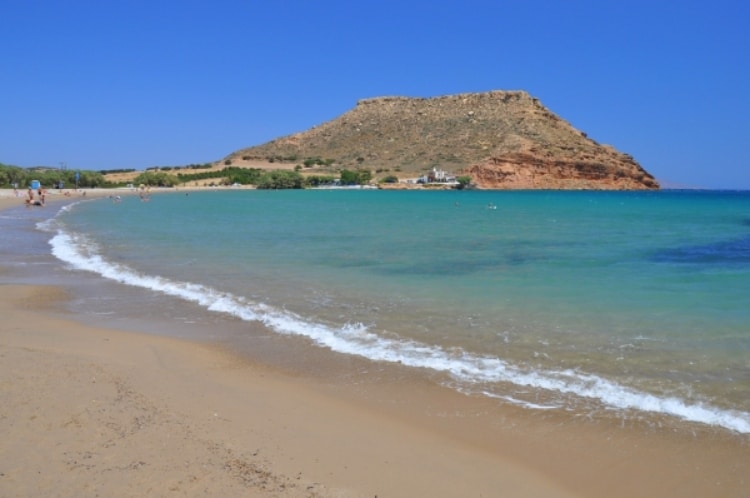 Opposite of Chiona beach are the islets of Grandes, as they usually call them. In fact, these are three small islets belonging to the province of Sitia. Prasonisi is the largest of the three and has the highest altitude. And this is… Just 31 meters! Beautiful is the beach that is formed in the middle of the island which looks like a natural swimming pool.
The southernmost islet is called Savoura and has an almost round shape, while the northernmost and smallest islet is called Paximadi and is essentially just a large rock. The islets are a protected archaeological area, while their shallow and rocky seabed is home to shipwrecks.
See the stunning images of the area from above, in the below video…
Read also:
Steno Linari: The exotic natural swimming pool in Euvoea island
Agios Fokas: The blue-green well-hidden secret of the Peloponnese
The beaches of Attica that offer you natural shade
Frequently Asked Questions
Chiona and Grandes are located in the easternmost part of Crete, Greece. Chiona Beach is situated east of Agios Nikolaos and very close to Sitia, while Grandes refers to three small islets located opposite Chiona Beach in the province of Sitia.
Chiona Beach got its name from 'chiona,' which means a locust-bean (carob) store. Historically, the entire region was dependent on the locust-bean trade, and merchants would store carob beans in these 'chiona' storage facilities before transporting them by ship.
The three islets of Grandes are Prasonisi (the largest with the highest altitude at 31 meters), Savoura (the southernmost with an almost round shape), and Paximadi (the northernmost and smallest, essentially a large rock). These islets form a protected archaeological area with a natural swimming pool between them.
Chiona Beach features calm shallow waters, fine golden sand, plenty of space for visitors, natural shade from tamarisk trees, and adjacent taverns serving fresh seafood and traditional dishes like 'kakavia' (a special fish soup). The beach is mainly visited by locals, making it less crowded than other tourist destinations.
Yes, Chiona Beach is ideal for families and swimmers. It has calm, shallow crystal-clear waters, making it safe for children. The beach offers ample space, natural shade from tamarisk trees, and is known for its peaceful atmosphere and beautiful surroundings, though it remains relatively undiscovered by international tourists.


