
• Ancient Greece
  • Religious Interest
  • Travel in Nature
  • Travel Cost Calculator
No Result
View All Result
Exploring Greece TV
  • HOME
  • ATHENS
  • ATTICA
    • East Attica
    • North Attica
    • South Attica
    • West Attica
    • beaches of Attica
    • Argosaronic Islands
  • GREECE
    • PELOPONNESE
    • WEST GREECE
    • CENTRAL GREECE
    • THESSALY
    • CENTRAL MACEDONIA
    • EAST MACEDONIA
    • THRACE
    • EPIRUS
    • IONIAN ISLANDS
    • AEGEAN ISLANDS
      • NORTH AEGEAN ISLANDS
      • SPORADES
      • CYCLADES
      • DODECANESE
    • CRETE
  • CYPRUS
  • MORE
    • Ancient Greece
    • Travel in Nature
    • Religious Interest
  • SO YOU KNOW
  • I AM GREEK
    • PEOPLE
  • Greek
Exploring Greece TV
  • HOME
  • ATHENS
  • ATTICA
    • East Attica
    • North Attica
    • South Attica
    • West Attica
    • beaches of Attica
    • Argosaronic Islands
  • GREECE
    • PELOPONNESE
    • WEST GREECE
    • CENTRAL GREECE
    • THESSALY
    • CENTRAL MACEDONIA
    • EAST MACEDONIA
    • THRACE
    • EPIRUS
    • IONIAN ISLANDS
    • AEGEAN ISLANDS
      • NORTH AEGEAN ISLANDS
      • SPORADES
      • CYCLADES
      • DODECANESE
    • CRETE
  • CYPRUS
  • MORE
    • Ancient Greece
    • Travel in Nature
    • Religious Interest
  • SO YOU KNOW
  • I AM GREEK
    • PEOPLE
  • Greek
No Result
View All Result
No Result
View All Result
Exploring Greece TV
  • Ancient Greece
  • Religious Interest
  • Travel in Nature
  • Travel Cost Calculator

Serres: The only place in Greece that has fallen meteorite

It might be very close to you...

Exploring Greece TV by Exploring Greece TV
in GREECE, Mainland Greece, SERRES
A A
Share on FacebookShare on Twittershare
—
—
—

The strange places and events of Greece are so many and the more we explore them, the more we like to discover them. So one of these strange things is the only confirmed meteorite fall in our country. Do you know where it’s happened and when? The only place in Greece that has fallen meteorite is in Serres. This story is of particular interest…

Calculate the cost to reach this destination

The only place in Greece that has fallen meteorite

So there is a place in our country where there is the only confirmed meteorite fall many years ago. It is called SERRES and the discovery took place in 1818. And the meteorite may have fallen in Greece, but today it is on exhibit at the NhM Naturhistorisches Museum Wien in Vienna.

The meteorite fell in Serres in 1818 and was noticed by two Germans who were nearby. They were the ones who handed it over, in fact, to the Ottoman commander of the region. However, the commander did not evaluate it as something important, so it was passed on as a gift to his German doctor.

After it had changed hands to the chemistry professor Andrea Scherer, the meteorite was finally donated in 1844 to the Vienna Museum of Natural History. It is finally the only meteorite that has been found so far on Greek soil. If you look at the International Meteorite Bulletin of the Lunar and Planetary Institute, you will find that it is officially mentioned as a meteorite of Greek origin.
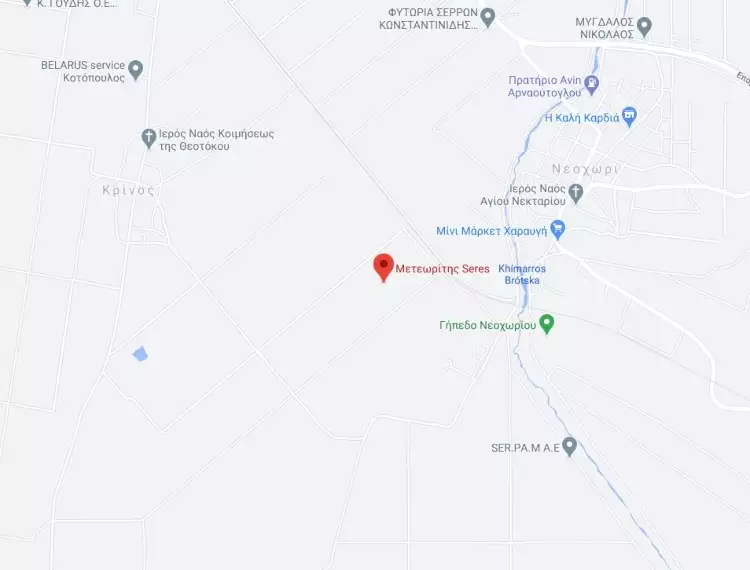
strange Greek SerresThe serrealismos page has created the historical sight on Google Maps outside Neochori Serres and you can see exactly where it is located by clicking HERE.

With the first opportunity you will be in Serres, it is interesting to see up close one of the strange places in Greece. Strange not because it has something special in itself. But because something unique happened there. After all, It’s not common a meteorite to… choose to fall on you anyway.

Photo Source: The Meteoritical Society, the International Society of Meteoritics and Planetary Science

Read also:

Timboulis: The mysterious house of Greece with dolls that change places

The Greek church that is one of the most strange in the world

The unknown strange formations and the lunar landscape of Greece

Frequently Asked Questions

The only confirmed meteorite fall in Greece occurred in Serres in 1818. The meteorite was discovered by two Germans in the area and is now housed at the Naturhistorisches Museum Wien (Museum of Natural History) in Vienna, Austria.

The meteorite fell in Serres, Greece in 1818. It was discovered by two German witnesses who were nearby at the time of the fall. The meteorite was later donated to the Vienna Museum of Natural History in 1844.

After the meteorite was discovered in 1818, two Germans handed it to the Ottoman commander of the region. The commander didn't recognize its importance and gave it as a gift to his German doctor. It eventually came into the possession of chemistry professor Andrea Scherer before being donated to the Vienna Museum of Natural History in 1844.

Yes, the Serres meteorite is officially recognized as a meteorite of Greek origin. It is mentioned in the International Meteorite Bulletin of the Lunar and Planetary Institute and is the only meteorite officially confirmed to have fallen on Greek soil.

The historical location of the meteorite fall in Serres has been marked on Google Maps by the serrealismos page, specifically outside Neochori in Serres. You can view the exact location by accessing the Google Maps marker provided on the serrealismos website.

Tags: Central MacedoniaMACEDONIAmeteoriteSERRESstrange Greece
ShareTweetShare

Related Posts

GREECE

The fairy-tale Grove with the ancient plane trees

Οχυρό Ρούπελ
CENTRAL MACEDONIA

Fort Roupel: The legendary monument – symbol of the struggle of the Greeks in the epic of the ’40s

EPIRUS

Skotina: The Greek village that has moved three times

Αρκαδία - Αγία Φωτεινή - Αρχαία Μαντινεία: Η ελληνική εκκλησία που αποτελεί μια από τις πιο παράξενες του κόσμου
Exploring Greece

Peloponnese: Agia Fotini, the Greek church that is one of the most strange in the world

Λοχίας Δημήτρης Ίτσιος: Η ιστορική μάχη με τις 33.000 σφαίρες - Β' Παγκόσμιος Πόλεμος
CENTRAL MACEDONIA

Sergeant Itsios: A legendary personality and the historic battle with 33,000 bullets

Diaporos
AEGEAN ISLANDS

Halkidiki: Diaporos, the Greek island that it has warm waters all the year-round

Sitia strange Greece
AEGEAN ISLANDS

Xerokampos: the otherworldly lunar landscape of Greece

Ancient Greece

The unknown ancient Greek city that no longer exists

Facebook Youtube Twitter Youtube Vimeo Instagram

our Webisites

ExploringGreece.tv

  • About ExploringGreece.tv
  • Data Protection Policy
  • Terms of Use
  • Website ID information
  • Contact us

See Also

  • Ancient Greece
  • Religious Interest
  • Travel in Nature
  • Travel Cost Calculator

Copyright © 2017-2026 Viewmax Media.

  • HOME
  • ATHENS
  • ATTICA
    • East Attica
    • North Attica
    • South Attica
    • West Attica
    • beaches of Attica
    • Argosaronic Islands
  • GREECE
    • PELOPONNESE
    • WEST GREECE
    • CENTRAL GREECE
    • THESSALY
    • CENTRAL MACEDONIA
    • EAST MACEDONIA
    • THRACE
    • EPIRUS
    • IONIAN ISLANDS
    • AEGEAN ISLANDS
      • NORTH AEGEAN ISLANDS
      • SPORADES
      • CYCLADES
      • DODECANESE
    • CRETE
  • CYPRUS
  • MORE
    • Ancient Greece
    • Travel in Nature
    • Religious Interest
  • SO YOU KNOW
  • I AM GREEK
    • PEOPLE
  • Greek
No Result
View All Result
  • en English
  • el Ελληνικα

Copyright © 2017-2026 Viewmax Media.

Trip Cost Calculator

Fill in the fields and click Calculate

From:
Origin
To:
Destination

Powered by ExploringGreece.tv
  • HOME
  • ATHENS
  • ATTICA
    • East Attica
    • North Attica
    • South Attica
    • West Attica
    • beaches of Attica
    • Argosaronic Islands
  • GREECE
    • PELOPONNESE
    • WEST GREECE
    • CENTRAL GREECE
    • THESSALY
    • CENTRAL MACEDONIA
    • EAST MACEDONIA
    • THRACE
    • EPIRUS
    • IONIAN ISLANDS
    • AEGEAN ISLANDS
      • NORTH AEGEAN ISLANDS
      • SPORADES
      • CYCLADES
      • DODECANESE
    • CRETE
  • CYPRUS
  • MORE
    • Ancient Greece
    • Travel in Nature
    • Religious Interest
  • SO YOU KNOW
  • I AM GREEK
    • PEOPLE
  • Greek
No Result
View All Result
  • en English
  • el Ελληνικα

Copyright © 2017-2026 Viewmax Media.

Newsletter

  • Greek