


We may admire the pure white of ancient statues and sculptures today, yet it seems this was not the preferred look for the artists who created them. Modern scientific methods reveal that the colorful — often vividly multicolored — appearance of ancient statues was completely normal. In fact, white was not the goal at all. Not even on the Parthenon…
Plato himself hints at how beautifully painted Greek architecture once was, describing an Athens very different from the one we imagine. Inscriptions also confirm that polychrome painting was considered as valuable as the sculptor’s craft. Over the centuries, however, the colors did not survive. Still, traces remain in the pores of the marble. In reality, ancient art was an explosion of color and ornate decoration. Phidias — the most renowned sculptor of his time — also created a colossal statue of Athena Parthenos to be placed inside the Parthenon. Although the statue has long been lost, we know its appearance from the writings of the ancient historian Pausanias, who describes it as chryselephantine: covered in gold and ivory.
The dazzling image of the Parthenon once had color
The Parthenon is undeniably the brightest monument of the Athenian state and the pinnacle of the Doric order. Construction began in 448/7 BC, and the temple was inaugurated in 438 BC during the Great Panathenaia. The final sculptural decoration was completed in 433/2 BC. According to the sources, the architects involved were Iktinos, Kallikrates, and possibly Phidias, who oversaw the sculptural program. It is one of the few surviving all‑marble Greek temples and the only Doric one with all its metopes carved in relief. Pentelic marble was used for its construction, except for the stylobate, which was made of limestone.
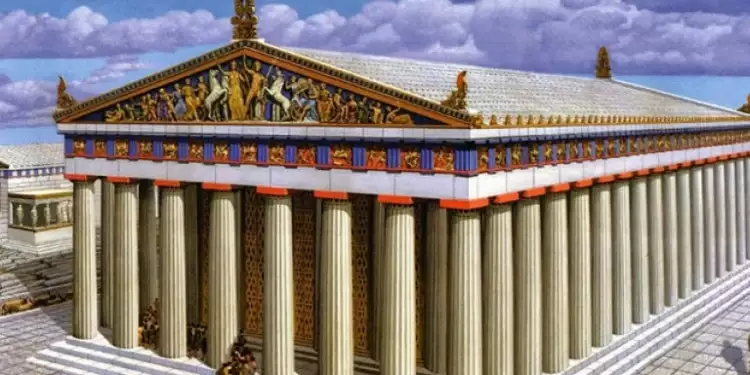
What many people do not know is that large parts of the sculptural decoration, the architrave, and the coffered ceiling once carried painted motifs in red, blue, and gold. In other words, the Parthenon did not always have the white appearance we see today — it was adorned with vibrant colors in several of its architectural elements.
The BBC even describes the Parthenon Sculptures as works once covered in an explosion of color and striking decoration.
A vivid reconstruction of the Acropolis of Pericles
An impressive production titled Interactive Tour of the Acropolis in the Age of Pericles by the Foundation of the Hellenic World offers a glimpse into that era. It is a 3D reconstruction of all the buildings on the Sacred Rock, complete with their architectural and chromatic details — both those that survive and those that have been lost, masterpieces of classical architecture. The famous sculptures that adorned them are also presented in the colors of their time.
And the images are truly spectacular…


Vacation In Greece
Read Also:
Acropolis: The oldest photograph was taken over 180 years ago
Parthenon: Five truths that many do not know
The secret church that the Acropolis hides at its feet
Follow exploringgreece.tv on Facebook and Instagram
Click on Exploringgreece.tv Google News, and press the “Follow” button to travel to Greece
Frequently Asked Questions
Yes, the Parthenon was originally painted in vibrant colors. Unlike the white marble structure we see today, the ancient Greek temple featured bright pigments including red, blue, yellow, and gold that covered its sculptures, friezes, and architectural elements.
The Parthenon was painted with a variety of colors including bright reds, blues, yellows, greens, and gold leaf. These pigments were applied to the marble surfaces, statues, and decorative elements to create a visually striking appearance that enhanced the temple's iconic status in ancient Athens.
The Parthenon's original paint faded and disappeared over centuries due to weathering, exposure to the elements, and various historical events. The pigments gradually wore away, leaving behind the white marble that became the iconic look we recognize today.
Archaeologists and historians have discovered evidence of the Parthenon's original paint through traces of pigment remaining on marble surfaces, ancient texts describing the temple's appearance, and scientific analysis of residual color compounds. These findings have been documented in academic research and archaeological studies.
When fully painted, the Parthenon would have appeared dramatically different from its current white marble state. The sculptures and architectural details would have been covered in vivid colors—reds, blues, and golds—creating a much more ornate and visually impressive appearance that showcased the wealth and artistic achievement of ancient Greece.


