


It is definitely the busiest and most crowded square in Greece. It’s the palce where people pass by imn order to go to their daily jobs. Tourists who visited Greece passed by it. For all people, old and young, who have gone for a walk or shopping in Athens, Syntagma Square is undoubtedly a trademark of the capital and one of the oldest in the country. It also belongs to the 100 largest squares in the world.
The history of Syntagma Square
Syntagma Square, in Athens, was named after the Constitution, which Was forcefully granted by King Otto due to the popular uprising of September 3rd in 1843. This square, together with the Omonia Square, have always been and are the two reference points of the city. Today it is surrounded by important buildings of Greece’s capital, namely the Parliament building, the historic hotel “Great Britain” and the buildings of other Central Public Bodies. However, it didn’t always have the look that it has today. In fact, if someone looked at old photos, they would see something completely different. A large area or – to be more accurate – a large field in the center of Athens.
In any case, Syntagma Square began to take its initial form in 1834. Until 1843, when the revolution of the people of Athens demanding a Constitution, took place it did not have an official name. In many writings, however, it is referred to as the “Palace Square”.
What was the Athens called before it acquired its present name.
The image of the Square in Athens, through time
As shown in the various historical photographs that have survived, until the middle of the 19th century, the “most important square of Athens” was in the form of a large field. The only characteristic that gives away its identity, is in fact the hill of the Acropolis. Once, it was visible from every point of the square. Of course, there was no fountain and the houses that surround it were few.
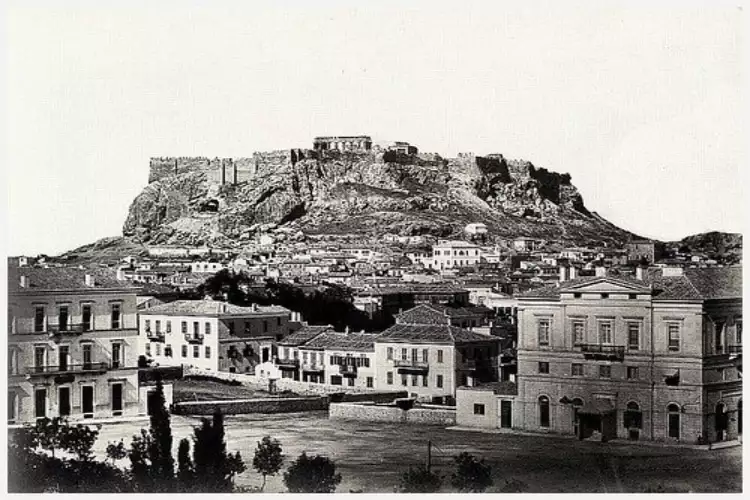
Syntagma Square, 1865. Photographer: Dimitrios Konstantinou
It gradually took the form of a square and in some photos we can see citizens walking on their way to work or just for a walk. Sometime in the early 20th century, Syntagma Square began taking the form of a European standards square . Surrounded by large neoclassical buildings, the streets were attentive and cars were circulating. More and more shops appeared. It was slowly becoming the main meeting place of the residents of the capital city.
This image is only now reminiscent by the historical photographs of old Athens…
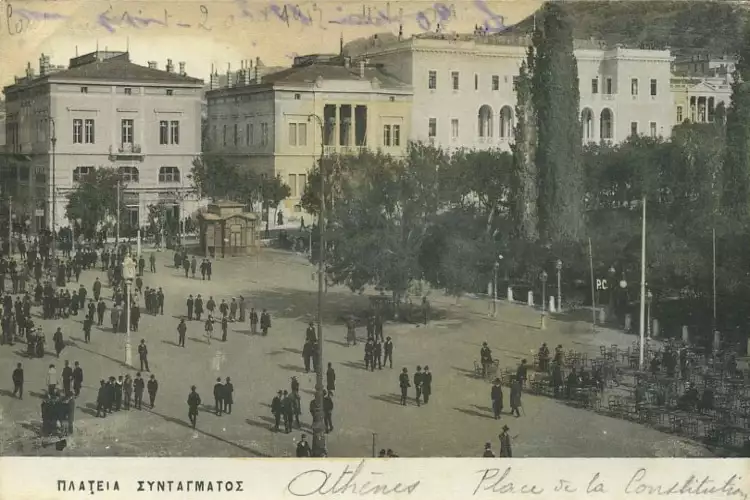
Syntagma Square in a letter book dated in 1912
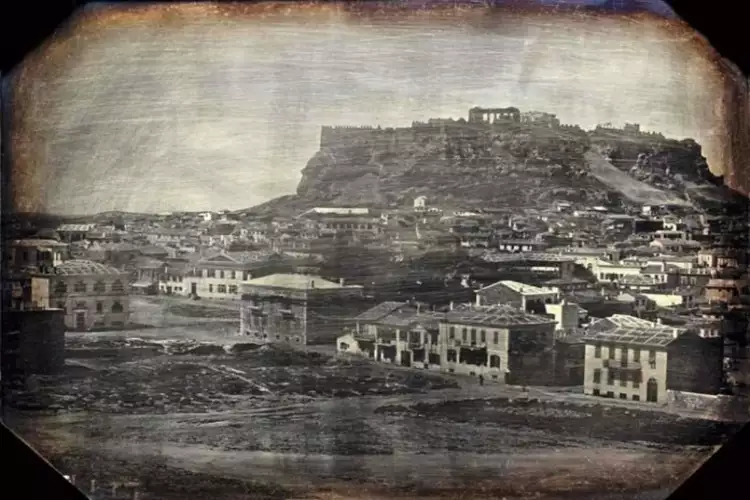
Syntagma. 1950. Photographer: Jean-Baptiste Louis Gro
External photography source: wikipedia.org
Which was The Agamon Square of Athens and why it was called so
Frequently Asked Questions
Syntagma Square was officially named in 1843 after the Constitution (Syntagma in Greek) that was granted by King Otto following the popular uprising of September 3rd, 1843. Before this date, it was often referred to as the 'Palace Square' in historical writings.
Until the middle of the 19th century, Syntagma Square appeared as a large field in the center of Athens. The only distinctive feature was the visible Acropolis hill from every point of the square. There were no fountains, few houses surrounding it, and it bore little resemblance to the modern plaza we know today.
Syntagma Square gradually transformed from the 19th to early 20th century. By the early 1900s, it began taking on European standards with large neoclassical buildings surrounding it, organized streets, circulating cars, and an increasing number of shops. It slowly became the main meeting place for Athens residents and the busiest square in Greece.
Yes, Syntagma Square in Athens belongs to the 100 largest squares in the world. It is undoubtedly the busiest and most crowded square in Greece and serves as a major landmark for both tourists and locals.
Today, Syntagma Square is surrounded by several important buildings including the Parliament building of Greece, the historic Hotel Grande Bretagne (Great Britain), and various Central Public Bodies. These buildings reflect the square's significance as the heart of Athens' political and administrative center.


