


One of the main features of Omonia square of the past is the muses that were placed there. It was June 1930 when Eleftherios Venizelos inaugurated the underground railway station in Omonia Square.
Up till then, the square was full of flowers, palm trees and wooden benches. The new square was circular, made according to the European standards and had marble railings at the entrances to the underground railway. The use of the underground railway in Omonia square also created the need for underground ventilation of the station. This is where the need for the placement of the Muses was acknowledged.
In order to cover the “holes” of the vents, in 1934, eight structures were placed around the square, called “the muses of the Omonia square”. At the base of each construction, there was a sitting statue depicting one of the muses of antiquity. And while the Muses were actually nine, only eight were placed in Omonia square. There was one missing, Calliope!
Calliope and how she was connected to the toilet !
The constructions, which were placed in Omonia square, were eight purely for reasons of aesthetics and symmetry. The muse that was left out was Calliope,the muse of epic poetry. Not only did the architect of the project not put her statue in the square along with the rest, but he also placed it in the basements of the electric railway, next to the public urinals!
It was indeed characteristic of the situation that, when people asked where the public urinals are, they got the answer: “Down next to Calliope! “ So the name of the gentle muse of epic poetry was identified with the toilet. That’s why later, when the soldiers had a chore in the toilets, said they had an appointment with “Calliope”.
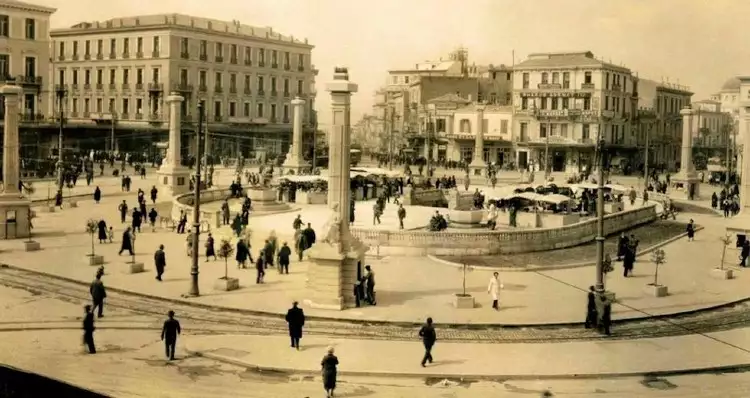
The muses of Omonia were considered by the Municipal Authority to be unsightly. As a result, the decision was made to remove them. The then mayor of the city, K. Kotzias who had already demolished the Municipal Theater made the decision easily. The occasion that everyone was waiting for, came in August of 1936, when, during demonstrations, a muse fell, injuring passers-by. A little while later the sculptures were removed once and for all.
All that remains to be reminiscent of the muses are the photos but also the historical phrase that remained…
The unknown giant Tower in the Acropolis district that no longer exists
Frequently Asked Questions
The Muses of Omonia Square were eight sculptural structures placed in the square in 1934 to cover underground ventilation holes for the newly inaugurated railway station. Each structure featured a sitting statue depicting one of the muses from ancient Greek mythology. Although there are nine muses in total, only eight were placed in Omonia Square, with Calliope, the muse of epic poetry, notably absent from the main square.
Calliope, the muse of epic poetry, was intentionally excluded from the main Omonia Square for aesthetic and symmetry reasons. Instead of placing her statue with the other eight muses, the architect positioned Calliope's statue in the basement of the electric railway next to the public urinals, which led to the historical phrase connecting her name with toilets.
The phrase 'Down next to Calliope!' emerged when people asked directions to the public urinals in Omonia Square. This humorous expression connected the name of the gentle muse of epic poetry with the toilet facilities. Later, soldiers referred to visiting the toilets as having an appointment with 'Calliope,' cementing this unusual association in Athens' historical slang.
The Muses of Omonia Square were removed in August 1936 by Mayor K. Kotzias. The Municipal Authority considered them unsightly and decided to remove them. The final decision to take action came after a muse fell during demonstrations and injured passers-by, providing the occasion to permanently remove all the sculptures from the square.
In June 1930, Eleftherios Venizelos inaugurated the underground railway station in Omonia Square, transforming the area. The square was redesigned in a circular European style with marble railings at the station entrances. The underground railway required ventilation systems that created 'holes' in the square, which eventually led to the placement of the eight Muses sculptures four years later in 1934.


