


It has been only 12 years since two students brought to light one of the largest and most impressive caves in Attica. The reason for the “Cave of Aphaia” on Mount Aigaleo is opposite the settlement of Aphaia in Haidari.
Aphaia Cave is a labyrinthine cave with exceptional beauty. However, it is not considered usable for public visits because of its high inclination. It is a cave that was discovered relatively recently, but the most impressive thing about it is the way it was discovered. His entrance was located by two children, Panagiotis Dionisiou and Dimitris Panagiotidis. In fact, they were rewarded for their discovery. It is quite possible that the entrance was recently opened, since opening works were being carried out in the area for the suburban train.
The cave was explored and mapped in 2008 by the Hellenic Speleological Society.
The history of the cave
This cave in Attica has been created by the enlargement of a branch, and it develops along its length. It has downhill development, but without the need for a rope. It has a small and somewhat narrow entrance and is downhill in its first meters. Stalactite columns, stalactites and stalagmites, stone basins, elitists and evacuees compose a multi-layered setting, from water and rock.
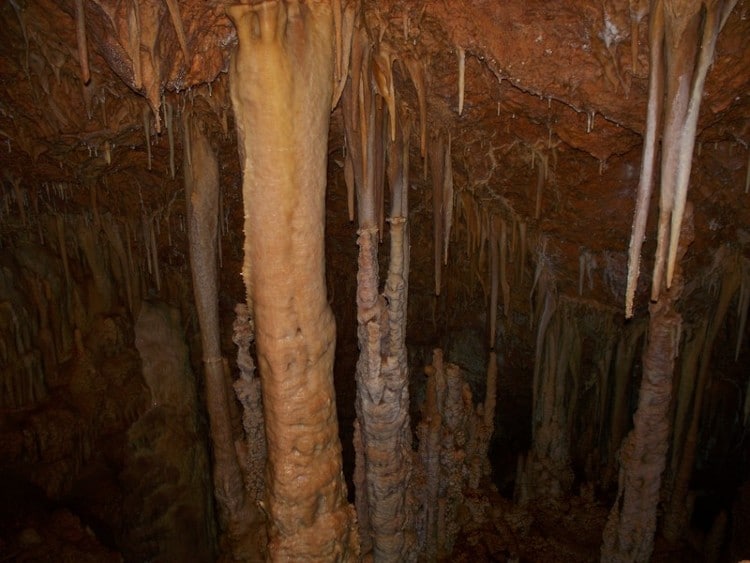
It is a cave with a long history. Millions of years of water, drop by drop, chiseled the rock and created beauty. Factors such as the temperature, the seismicity of the area, and the nature of the rocks created these pits and the eroded rocks formed this remarkable natural decoration of the cave. In the last room, there are also uniquely beautiful helictites that count hundreds of thousands of years of life.
This spacious cave in Attica is proof of the beauty and mystery that lies beneath our feet even in Attica. And even if we can’t visit all these places, it’s worth knowing them through descriptions and images.
Photo Source: xaidarisimera.gr
Read Also:
The unknown cave with anaglyph, one hour from the center of Athens
The Greek cave with the… holes, ceiling facing the sky
The impressive cave of Aggitis in Drama counts 30,000 years of life
Frequently Asked Questions
The Cave of Aphaia is one of the largest and most impressive caves located on Mount Aigaleo in Attica, Greece, opposite the settlement of Aphaia in Haidari. It is a labyrinthine cave with exceptional beauty featuring stalactites, stalagmites, stone basins, and heliktites that are hundreds of thousands of years old.
The Cave of Aphaia was discovered by two students, Panagiotis Dionisiou and Dimitris Panagiotidis, approximately 12 years ago. The entrance was likely exposed during suburban train construction works in the area, and the discoverers were rewarded for their find. The cave was officially explored and mapped by the Hellenic Speleological Society in 2008.
The Cave of Aphaia is not considered suitable for public visits due to its high inclination and steep terrain. While it features a small and narrow entrance with downhill development that doesn't require rope initially, the cave's challenging topography makes it inaccessible for regular tourism.
The Cave of Aphaia was created by the enlargement of a water branch over millions of years. Water droplets gradually chiseled the rock, while factors such as temperature, seismic activity, and the nature of the rocks contributed to creating the cave's formations, including stalactites, stalagmites, and stone basins.
The Cave of Aphaia contains impressive geological formations including stalactite columns, stalactites, stalagmites, stone basins, and uniquely beautiful heliktites in the last chamber. These formations showcase millions of years of geological history and water erosion, creating a multi-layered natural decoration of rock and mineral deposits.


