


Exploring the caves in Greece is a must for anyone interested in geological wonders. These natural formations are hollow spaces inside the earth that were formed by the effects of earthquakes and water erosion on rocks. Inside the caves, you can see amazing shapes of stalactites and stalagmites that were carved by water over time. In ancient times, people used to live in these caves and later used them for worship. Greece has more than 8,500 caves that have been recorded, but only a few of them are open to visitors. We have selected five of the most beautiful ones for you.
Caves in Greece – Koutouki Cave


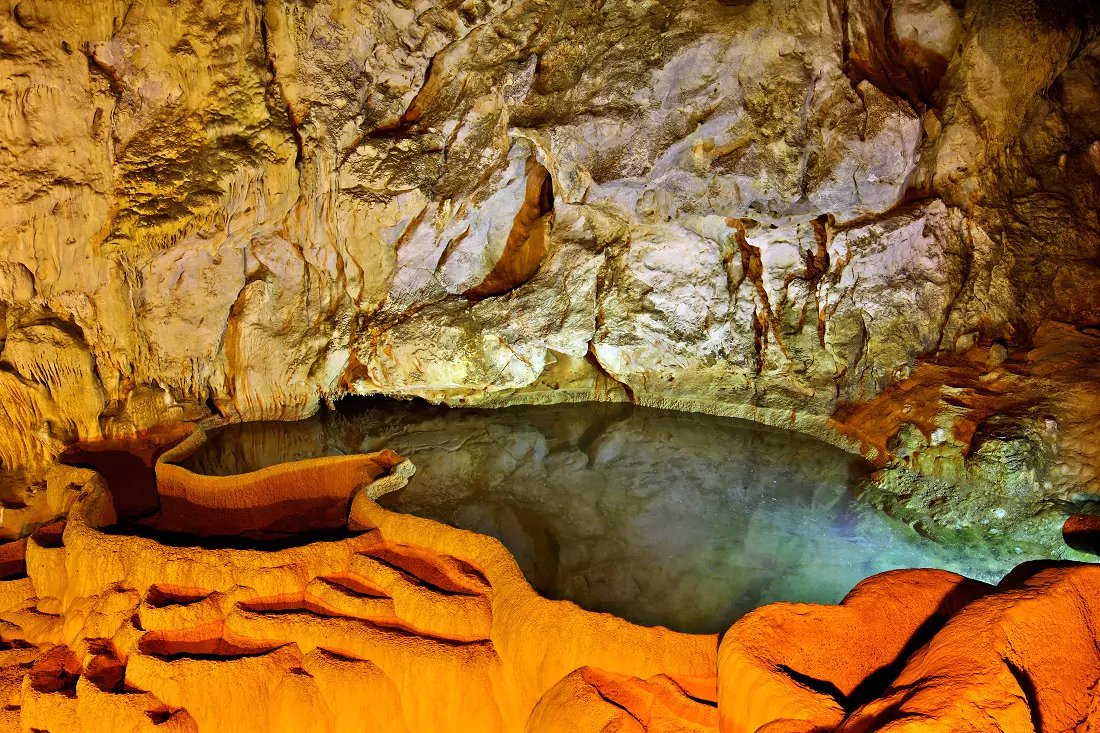
Caves in Greece – Cave of the Lakes

If you’re interested in hiking, you can plan a walk in Zachlorou, a village in Peloponnese with the only route in Greece.
Caves in Greece – Perama Cave


If you’re interested in discovering picturesque villages, it’s worth visiting Kapesovo in Ioannina where most residents have ancient names.
.
Caves in Greece – Cave of Aggitis Springs


Visitors move in an artificial corridor above the river, opposite the flow of water, watching the natural decoration in the Cave which is dominated by white and red stalactites of various forms. Accessible is 2.5 km but the first 500 meters can be visited. The constant temperature is 17°C. The exit from the cave is very impressive and is made through a small arched opening at the base of our small room (called the wheel room). The hall has a diameter of 40 meters and a height of 15 meters. Exiting the cave you will see the exit of the river in an idyllic green landscape where you can rest and admire the wonderful natural landscape.
In this wider area, archaeological excavations brought to light important paleolithic and paleontological findings. One of the very important findings is a mammoth tusk which is now kept in the Archaeological Museum of Drama.
If you’re interested in exploring more places in Drama, you can check out 10+1 stops in one of the most historic cities in Greece.
Caves in Greece – Holy Galas Cave

The Cave of Agio Galas is located on the beautiful island of Chios and was mapped in 1969. It is located at the northwestern tip of the island in the homonymous village that is sixty-five (65) kilometers from the city. The route itself to the village is magnificent. In fact, the village is built on the rock where the cave system is opened. It is a cave with special morphology and great archaeological importance.
The visitor passes through chambers and apartments full of impressive stalactite complexes which are revealed in spacious halls and labyrinthine chambers with balconies, windows, bridges, and burrows. There is also a legend about the cave.

It tells the story of a leper exiled by her father, the daughter of a Byzantine emperor, who was cured by drinking the milky liquid (“Holy Milk”) that dripped inside the cave. When after three years the King repented and sent her back, his envoys found her healed.
If you’re interested in exploring more places in Chios, you can visit Mesta, a unique castle in Greece. The experience will be unforgettable!”
Did you know?
Caves in Greek mythology were identified with Tartarus who was a minor deity of the underworld, son of Pluto or Aether or Chaos and Gaia. Tartarus, however, seems to be at the same time a mythical place, called the same name, Tartarus. In Tartarus, according to ancient beliefs, the bad guys were tortured after their death. Homer mentions many persons who were sent to this place for their “living” crimes such as Tityon, Tantalus, and Sisyphus. The ancients believed that the entrances to Tartarus were the caves.
The belief that caves were entrances to Tartarus was so strong that it was even mentioned in ancient literature. For example, in the Odyssey, Homer describes how Odysseus and his men enter the cave of Polyphemus and are trapped there by the Cyclops.
Travel to Greece – Google News – Follow us
Also, read:
The cave in Attica which according to legend was a passage to Hades
Amorgos: one of the Cyclades’ amazing monasteries
Pelion: The legendary train, a historic route
Follow exploringgreece.tv on Instagram and Facebook
Frequently Asked Questions
Greece has more than 8,500 recorded caves, though only a few are open to visitors. The country is home to some of the most impressive geological formations in the world.
Perama Cave is the largest cave in Greece, covering 4.8 acres with a total area of 14,800 square meters. It is located in Ioannina and ranks 6th in the world for corridor length with 1,700 meters.
Koutouki Cave is located in Paiania at an altitude of 510 meters on the eastern outskirts of the Hymettus massif, approximately 35 kilometers from Athens in Attica.
The Cave of the Lakes is unique because it contains 13 successive lakes at different altitudes on three different floors, separated by dams made of stalactite material. This feature is extremely rare and makes it one of the most impressive caves in the world.
Koutouki Cave was discovered accidentally in 1926, with its interior explored in 1928. The cave was officially mapped in 1954 by speleologists Ioannis and Anna Petrocheilou.
Caves in Greece were formed by the effects of earthquakes and water erosion on rocks. Most are limestone caves created due to the high solubility of limestone in rainwater over millions of years.
The temperature inside Greek caves varies slightly. Koutouki Cave maintains a temperature of 17°C, while Perama Cave has an indoor temperature of 18°C with humidity reaching 100%.
Perama Cave is located just 5 kilometers from Ioannina city center on the road to Metsovo, situated on Goritsa Hill at the feet of Lake Pamvotis.
In ancient times, people used Greek caves as living spaces and for worship purposes. During World War II, the inhabitants of Perama used the cave as a refuge.


