


There are so many islands and islets in Greece that it’s hard to know them all. And the truth is that the Aegean Archipelago is dotted with unknown treasures and special secrets. There are islands, apart from those known to all of us, with few or no inhabitants, special natural beauty, unique beaches and special landscapes. There are some with unique features you may have never heard of. Like, for example, the island of pumice stone, called Gyali (Glass).
Gyali, the eight-shaped island of pumice stone
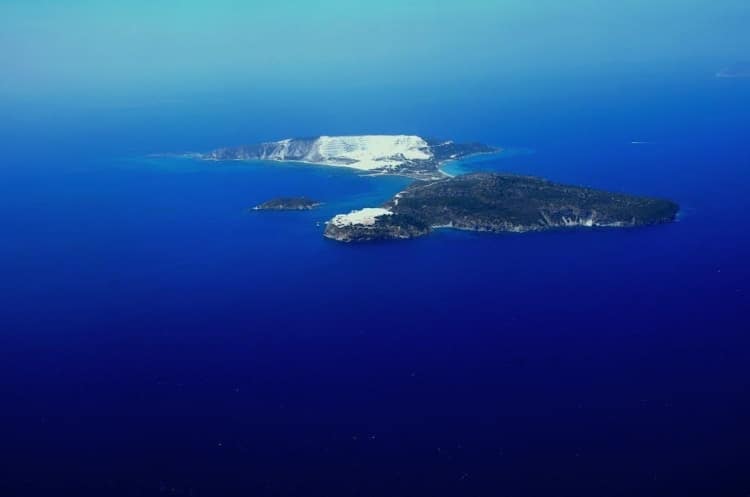
It is an island, only six miles from Turkey, between Kos and Nisyros. It belongs to the Dodecanese and is a really special place, unknown to most. Its shape is characteristic which looks like the number eight if seen from above. It is a small island that has a rich history. An ancient cemetery has been found there, the remains of a settlement of the Final Neolithic Period (4000 BC) and two crucibles with copper melting slags dating back to 6000 BC which prove the early use of metallurgy.
The inhabitants of the island are few. Just about 20 people. But there are many more people coming to work on the island. The visiting workers, of course, go there for the unknown, to many, open mines of the island that make pumice and perlite!
The mines are also the ones that make the landscape of Gyali unique: The beautiful forests with the arbutus and pine trees interchange with the open mines and this is one reason why the island has been declared as a landscape of Natural Beauty. They call it an island of pumice stone and not unfairly since the quantities that exist there cannot be not easily found elsewhere in Greece.
If you now travel to a nearby island and get there by boat, you will have a unique experience. Swimming there is a really fantastic experience, while excursion boats also make day trips to the southwest coast, with the sea caves and inaccessible beaches.
How Gyali island mine works
A private company has been operating the mine, which is owned by the Municipality of Nisyros, since 1952. The mine is open-air and its exploitation is done by the method of the right steps. First, the revealing of the deposits takes place and then the extraction with the help of thrusters.
This is followed by the treatment, consisting of the granulometric gradation of the material in a circuit of static and vibrating sieves. Then a small part is broken with the help of crushers.
The finished products (pumice stone of variant granulometry) are deposited via conveyor belts and loaded on ships to ordering customers.
External photography source: Dr Petros Tzeferis
The island next to marathon that 96 castaways found shelter
Frequently Asked Questions
Gyali is a small island in the Dodecanese archipelago, located only six miles from Turkey, positioned between the islands of Kos and Nisyros in the Aegean Sea.
Gyali is called the pumice stone island because it contains vast quantities of pumice stone that are not easily found elsewhere in Greece. The island has been mined for pumice and perlite since 1952 through open-air mining operations.
Gyali has only about 20 permanent inhabitants. However, many more workers come to the island to work in the pumice and perlite mines operated by a private company.
Gyali has a distinctive eight-shaped appearance when viewed from above. The island has been declared a landscape of Natural Beauty due to its unique features, including beautiful forests with arbutus and pine trees interspersed with open mines, sea caves, and inaccessible beaches.
Gyali has rich historical importance, with archaeological findings including an ancient cemetery, remains of a Final Neolithic Period settlement dating back to 4000 BC, and two crucibles with copper melting slags from 6000 BC that demonstrate early metallurgy use in the region.


